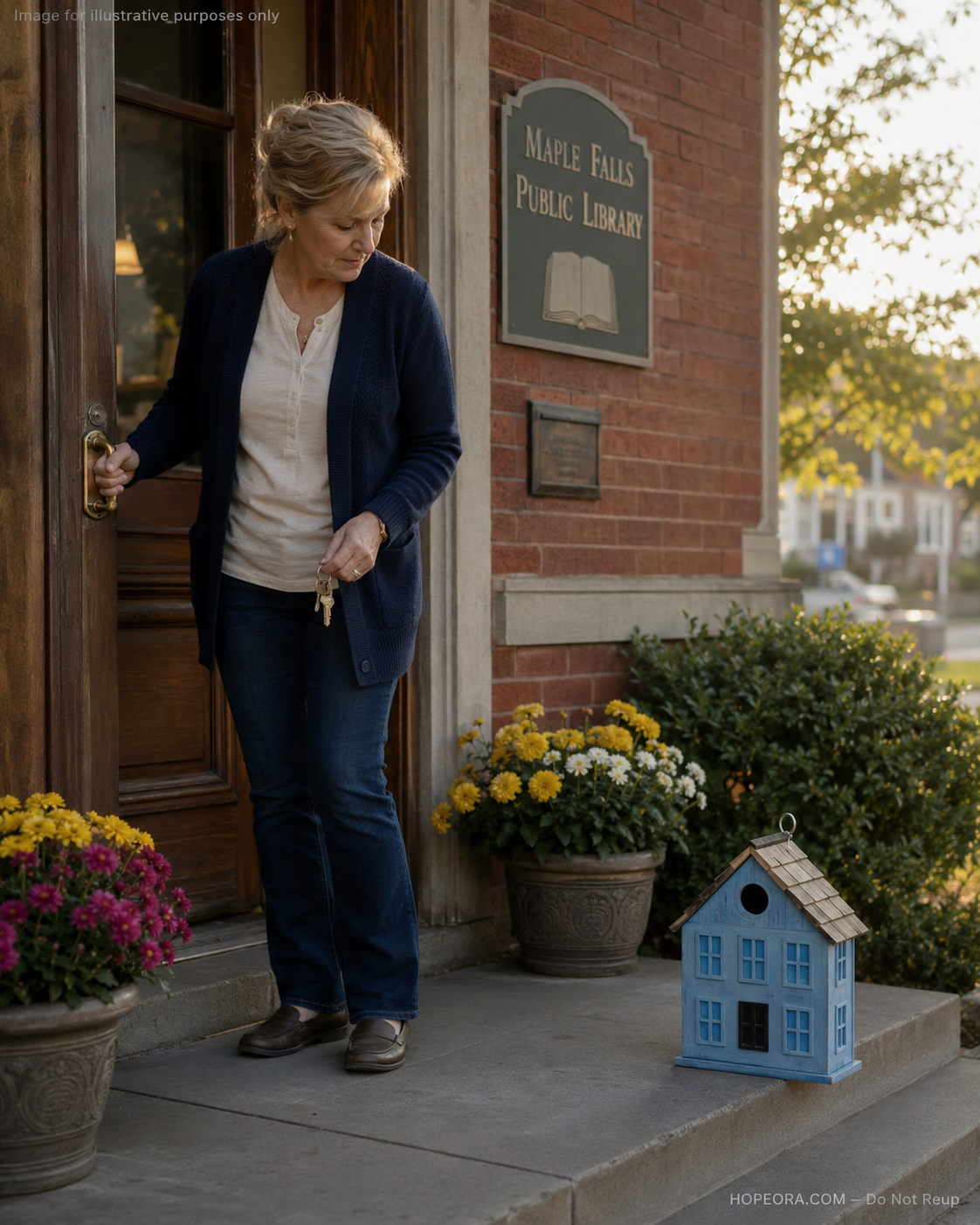
A Blue Birdhouse Arrived While My Husband Was Away—One Black Window Changed Everything
The first people through the doors of Maple Street Library every Wednesday morning were almost always the same.
Mr. Hollis came in for western novels.
Mrs. Greene returned three books she insisted she hadn’t finished, then checked them out again.
Around ten o’clock, the preschool children arrived from First Baptist Church with construction-paper name tags hanging crookedly around their necks.
Evelyn Carter could have set the clock by them.
She liked that.
Small towns rarely stayed exactly the same, but they repeated themselves enough to remind people they belonged somewhere.
At sixty-one, Evelyn had worked behind the same oak circulation desk for nearly twenty-five years. Children she once helped find picture books now walked in wearing sheriff’s badges, nurses’ scrubs, or Army uniforms home on leave.
Most still called her Miss Evelyn.
She never corrected them.
That Wednesday began no differently.
She straightened a display of books about local history, filled the coffee maker in the tiny staff room, and opened the front doors just before nine.
Outside, Main Street was already waking up.
The diner across the road had a line stretching onto the sidewalk.
Someone was washing windows at Peterson Hardware.
The church bell rang once on the hour.
It was the kind of morning people forgot almost as soon as it passed.
Tom would have liked it.
Her husband had spent the past four days traveling with a nonprofit that repaired wheelchair ramps and porches for disabled veterans across the county. Retirement hadn’t slowed him down. If anything, it gave him more reasons to leave the house carrying a toolbox.
Before driving away Sunday afternoon, he had stood on the front porch tying his work boots.
“You’ll remember to lock the back door?”
“I usually do.”
“You usually forget.”
“I remember forgetting.”
He laughed.
“So that’s progress.”
He kissed her forehead, picked up the old blue cooler that went everywhere with him, and climbed into the pickup.
Neither of them waved dramatically.
After thirty-six years together, departures had become quiet things.
Around lunchtime, the delivery truck stopped outside the library.
Not unusual.
People donated books every week.
Sometimes puzzles.
Sometimes old family Bibles nobody wanted to throw away.
The driver carried in a medium-sized cardboard box with no shipping company printed on it.
“Package for Evelyn Carter.”
“I wasn’t expecting one.”
He shrugged.
“Happens.”
She signed the clipboard.
The return address line was blank.
No sender.
Only her name.
She carried the box into the workroom behind the circulation desk.
Martha, the assistant librarian, glanced over her reading glasses.
“Another box of romance novels?”
“I hope not.”
“They always smell like someone’s attic.”
Evelyn smiled.
“They deserve better attics.”
She found a letter opener and carefully cut through the tape.
Inside, newspaper had been folded neatly around something wooden.
She lifted it out with both hands.
A birdhouse.
Handmade.
Solid pine.
Painted a soft blue that had faded just enough to look older than it probably was.
The roof had been sanded smooth.
Tiny white shutters framed each little window.
Someone had taken their time making it.
“It’s beautiful,” Martha said.
“It is.”
There was no note.
No receipt.
No explanation.
Only the birdhouse.
Evelyn turned it slowly.
One side caught the afternoon light.
Then she stopped moving.
One window.
Just one.
Had been painted black.
Not weathered.
Not stained.
Painted.
Neatly.
Deliberately.
Her thumb rested against the unfinished wood beneath it.
She didn’t say anything.
Martha looked up.
“What is it?”
Evelyn shook her head once.
“I’m not sure.”
She set the birdhouse on the table.
For several seconds neither woman spoke.
Finally Martha laughed softly.
“Maybe the painter ran out of blue.”
“Maybe.”
But Evelyn didn’t sound convinced.
She reached into the box again.
Nothing.
No card.
No packing slip.
Nothing tucked beneath the paper.
Just the empty box.
The black window seemed darker now.
Not because of the paint.
Because of something she hadn’t thought about in years.
Long before she worked at the library, before she married Tom, before gray found its way into her hair, her father had worn a sheriff’s badge every day except Sundays.
He wasn’t a man who frightened children.
He fixed bicycles.
He carried peppermints in his shirt pocket.
He shook hands too firmly.
But once, after coming home very late, he had placed both hands on the kitchen counter and looked at Evelyn for a long moment.
“If you ever see a blue birdhouse with one black window…”
He had stopped there.
Her mother came into the room carrying supper.
The conversation ended.
Evelyn remembered asking him about it years later.
He only smiled.
“Some things belong in old files.”
She had never asked again.
Until now, she had almost forgotten he’d ever said it.
The library phone rang.
A patron wanted to renew three mysteries.
A little boy asked where the dinosaur books had gone.
Someone dropped a stack of cookbooks into the return bin loud enough to make everyone jump.
The day continued.
Evelyn answered every question.
Stamped every due date.
Smiled at every visitor.
Yet each time she looked through the open doorway into the workroom, the blue birdhouse was still sitting there.
Waiting.
Near closing time, she stepped outside with her cell phone.
Tom usually answered before the second ring.
This time it rang until voicemail.
She waited a few minutes and tried again.
Nothing.
She slipped the phone back into her pocket.
Across the street, the church volunteers were setting up folding tables for Saturday’s veterans’ pancake breakfast.
Children chased each other across the lawn.
Somewhere a lawn mower started.
Everything looked exactly as it should.
When she walked back inside, Martha was standing beside the worktable.
“I didn’t touch it,” she said quietly.
“I know.”
“You ever going to tell me why you’re staring at that little birdhouse like it belongs to somebody else?”
Evelyn looked at the black window.
Then, almost without thinking, she picked up the phone on her desk—not to call Tom again, but to dial the one retired deputy in town who had served beside her father for nearly thirty years.
When he answered, she spoke only one sentence.
“I think someone just sent me something Dad hoped I’d never see.”
There was a long silence.
Then the old deputy asked, very softly,
“Has anyone else seen the black window?”
Part Two
The retired deputy arrived before the library lights were turned off.
Frank Dawson had been out of uniform for almost fifteen years, but he still carried himself the way men did after decades of answering calls at all hours. He removed his cap before stepping inside.
“You still lock this place at six sharp?”
“Most evenings.”
He looked past her.
“The birdhouse?”
Evelyn nodded.
She led him into the workroom without another word.
Frank stopped a few feet away from the table. He didn’t touch the birdhouse. He simply stood there, his hands resting on the back of a chair.
For a long moment, neither of them spoke.
Finally he asked, “Who delivered it?”
“I don’t know.”
“No note?”
She shook her head.
“No signature.”
He leaned forward just enough to study the black window.
“I hoped I’d never see one again.”
Martha quietly excused herself and closed the workroom door behind her.
Frank let out a slow breath.
“Your father never wrote that case down where anyone could find it.”
“So there was a case.”
“There was something.”
“What kind of something?”
He rubbed his jaw.
“The fewer people who knew, the better.”
Evelyn waited.
He had always respected silence more than questions.
Finally he said, “If your dad didn’t tell you, I’m not going to start tonight.”
She looked at the birdhouse again.
“Then why come?”
“Because you called.”
That was all he offered.
Before leaving, Frank turned back toward her.
“If Tom calls…”
“He hasn’t.”
“…tell him not to come straight home.”
She looked up.
“Why?”
But he was already reaching for the door.
“I’ll stop by tomorrow.”
Then he left.
Questions That Wouldn’t Go Away
That night the birdhouse sat on Evelyn’s dining room table.
She tried reading.
She folded laundry.
She watered the fern on the back porch.
Every so often she looked toward the table.
The black window always seemed to be facing her.
Around eight-thirty she called Tom again.
Voicemail.
She left a message this time.
“Just call when you can.”
Nothing more.
She placed the phone beside her teacup and turned off the kitchen light before going upstairs.
Thursday morning arrived with sunshine, church bells, and a line at the bakery.
Maple Falls looked exactly like Maple Falls.
Mr. Jenkins waved from the barber shop.
Two high school boys were repainting the veterans’ memorial fence before Saturday’s fundraiser.
Someone had hung fresh bunting outside City Hall.
Life had kept its appointment.
Evelyn unlocked the library doors at nine.
The children from summer reading camp rushed toward the craft tables.
One little girl carried a stack of books almost as tall as herself.
“They’re too heavy,” Evelyn said.
“I can do it.”
“I know.”
She took only the top two.
The girl smiled and kept walking.
Mrs. Alvarez arrived twenty minutes later carrying homemade oatmeal cookies for the staff.
“Tom still away?”
“For another couple of days.”
“Tell him we saved him extra blueberry pancakes.”
“I will.”
Evelyn smiled.
Nothing in her face invited another question.
By late morning her phone vibrated.
Not Tom.
His voicemail notification.
No missed call.
Just another reminder that the mailbox was full.
She frowned.
Tom never let it fill up.
She tried again.
Straight to voicemail.
Near noon a county volunteer coordinator walked into the library.
His orange safety vest was folded over one arm.
“Evelyn?”
“Morning, Bill.”
“You heard from Tom?”
“Not yet.”
Bill hesitated.
“We’re trying to finish assignments for the wheelchair ramp project.”
“I thought they were still in Pine Ridge.”
Bill blinked.
“They were supposed to leave Tuesday.”
She waited.
He shifted his weight.
“Tom never checked in.”
Neither of them spoke for several seconds.
“You sure?”
Bill nodded once.
“We figured maybe he’d decided to stay home with you.”
“He didn’t.”
Bill looked uncomfortable.
“If he calls, tell him to give us a ring.”
“I will.”
After he left, Evelyn stood beside the circulation desk watching the front door close.
Then she picked up the next returned novel and scanned it into the system.
The line of patrons kept moving.
That afternoon the library hosted its weekly coffee hour for local veterans.
It had started years earlier with four folding chairs.
Now nearly twenty people came every Thursday.
Some talked.
Some simply sat together.
Tom rarely missed it.
His empty chair stayed against the wall.
No one mentioned it at first.
Eventually one of the older veterans asked,
“Tom still fixing ramps?”
“That’s the plan.”
The man nodded.
“Good fellow.”
Another veteran looked toward the empty chair.
“He usually brings cinnamon rolls.”
A few people chuckled softly.
The conversation moved on.
Evelyn poured coffee into paper cups.
Refilled the sugar bowl.
Collected empty napkins.
She never looked toward the chair again.
When everyone had gone home, Martha appeared beside her with two cardboard boxes of donated books.
“You missed lunch.”
“I know.”
“I’ve got half a turkey sandwich.”
“I’m fine.”
“You always say that.”
Martha set the sandwich on the counter anyway.
After a minute she asked quietly,
“Is this about the birdhouse?”
Evelyn nodded.
“Frank knew something.”
“He tell you?”
“No.”
Martha crossed her arms.
“So what now?”
Evelyn looked through the front windows.
Across the street, volunteers were hanging banners for the weekend fundraiser.
An American flag moved gently above the courthouse.
“I keep opening the library.”
“What about after that?”
“I don’t know yet.”
She locked up a little after six.
The birdhouse was wrapped in an old quilt on the passenger seat beside her.
Instead of driving home, she turned toward the edge of town.
Her father’s farmhouse had been empty since his funeral eight years earlier.
She still kept the keys.
The porch creaked the same way it always had.
Inside, everything smelled faintly of cedar and old paper.
Dust rested on the bookshelf in his study.
His reading glasses still sat beside an atlas.
Nothing looked disturbed.
She switched on the desk lamp.
Its yellow light spread across the worn oak surface.
One drawer.
Then another.
Old tax receipts.
Fishing licenses.
Town maps.
Nothing unusual.
She reached for the bottom drawer.
It resisted.
She pulled harder.
Something caught inside.
After another tug, the drawer slid open just enough for her to reach in.
Her fingers brushed a small metal box taped beneath the desk.
No label.
No keyhole.
Only one envelope taped to the lid.
In her father’s careful handwriting were six words.
Not for the Sheriff’s Office. For Tom.
Part Three
Evelyn carried the metal box home without opening it.
It rested on the passenger seat beside the blue birdhouse, both wrapped in the same old quilt. At every stoplight, she glanced at them. Neither seemed to belong in her quiet life, yet both now sat inside it.
She waited until morning.
Her father had believed in mornings.
“Never make a hard decision after dark,” he used to say while pouring the first cup of coffee. “The sun has a way of correcting people.”
The kitchen clock read 6:18 when she slipped a butter knife beneath the yellowed tape sealing the envelope.
Not for the Sheriff’s Office. For Tom.
Inside was a single folded page.
Only one sentence.
If you’re reading this, it means I was right to trust you. Don’t let them bury it again.
No signature.
No explanation.
Only her father’s handwriting.
Beneath the note lay three small spiral notebooks, their black covers worn smooth around the corners.
She recognized them immediately.
Her father carried notebooks like those everywhere.
Church meetings.
Town council sessions.
Friday football games.
He said memories faded faster than ink.
She opened the first one.
Dates.
License plate numbers.
Property records.
Names she remembered from childhood.
Most belonged to people who had lived in Maple Falls all their lives.
The last pages were different.
Several names had been crossed out.
Others had circles around them.
One appeared over and over.
Harold Whitmore.
The former county treasurer.
A man everyone knew.
He sat in the front pew every Sunday.
Sponsored Little League uniforms.
Paid for the new flagpole outside the high school.
People still called him “Mr. Whitmore,” even though he had retired years earlier.
Evelyn closed the notebook.
She had expected secrets.
She hadn’t expected familiar names.
By eight o’clock she was unlocking the library.
Martha arrived carrying cinnamon rolls.
“You look like you slept here.”
“I didn’t.”
“You find something?”
Evelyn nodded once.
“Anything you can tell me?”
“Not yet.”
Martha accepted that answer.
She always had.
The morning passed with its usual rhythm.
A young mother searched for books about Alzheimer’s.
Two brothers argued over the last baseball biography.
Mr. Hollis forgot where he’d left his glasses.
“They’re on your head,” Evelyn said.
“They always are.”
He smiled.
“So long as somebody remembers.”
She smiled back.
Nothing in her voice suggested the notebooks waiting inside her desk drawer.
Just after lunch, Sheriff Daniel Ruiz walked through the front doors.
He removed his hat.
“Evelyn.”
“Morning, Sheriff.”
“I hear Frank stopped by.”
“He did.”
Ruiz looked toward the reading room before speaking again.
“Mind if we talk?”
She led him into the staff office.
He closed the door.
“We’ve been trying to locate Tom.”
“I know.”
“No activity on his credit cards.”
She nodded.
“His truck wasn’t at the volunteer site.”
“I know.”
Ruiz rested both hands on the table.
“Did Tom ever mention your father’s old investigation?”
“No.”
“Did your father?”
“Very little.”
Ruiz watched her for a moment.
“If you remember anything…”
“I’ll tell you.”
He thanked her and left.
Neither of them mentioned the notebooks.
That afternoon Frank Dawson returned.
He looked more tired than he had the evening before.
“I’ve been thinking.”
“So have I.”
She placed one notebook on the table between them.
He stared at it.
“You found those?”
“They were taped beneath Dad’s desk.”
Frank removed his glasses.
“I wondered where he’d hidden them.”
“You knew?”
“I knew he’d hidden something.”
He slowly turned the notebook toward himself.
His finger stopped at Harold Whitmore’s name.
He said nothing for several seconds.
Finally he whispered,
“Ron never stopped digging.”
“You knew that too.”
“I tried to get him to.”
Frank looked out the library window toward Main Street.
“Some folks become too important for people to question.”
Late that afternoon another visitor arrived.
A state investigator.
She introduced herself simply as Laura Briggs.
She carried a thin folder beneath one arm.
“We’ve been asked to assist.”
She opened the folder.
“There was something else.”
Inside were copies of volunteer sign-in sheets from the veterans’ organization.
Tom’s signature appeared on Monday morning.
Nothing after that.
Then another page.
Security footage from a gas station thirty miles away.
A still photograph.
Tom stood beside his pickup.
Across from him stood Harold Whitmore.
The image was grainy.
Neither man appeared angry.
They simply looked as though they were talking.
Laura slid the photograph across the table.
“Do you recognize him?”
Evelyn looked once.
“Yes.”
“Did they know each other?”
“I don’t know.”
Laura nodded.
“We’re trying to understand why they met.”
She closed the folder.
“We’ll stay in touch.”
News travels differently in a small town.
It doesn’t explode.
It drifts.
Across church parking lots.
Through grocery store checkout lines.
Between coffee refills at the diner.
By Friday morning people had begun asking careful questions.
“Any word from Tom?”
“He all right?”
“He’ll turn up.”
Some smiled kindly.
Others looked away too quickly.
Evelyn answered every question the same way.
“We’re waiting.”
Nothing more.
Saturday brought the veterans’ pancake breakfast.
Tom had helped organize it every year since retiring.
His name still appeared on the banner hanging outside the fellowship hall.
Several volunteers quietly removed it before breakfast started.
No one asked permission.
No one explained why.
Evelyn noticed.
She walked inside carrying two trays of coffee.
Mrs. Alvarez met her near the serving line.
“You don’t have to work today.”
“I signed up.”
“We can manage.”
“I know.”
She tied on an apron.
Poured coffee.
Wiped tables.
Refilled syrup bottles.
The work needed doing whether people were talking or not.
Across the room two men lowered their voices when she walked by.
One folded his newspaper.
The headline was visible for only a second.
Missing Volunteer Linked to Decades-Old Records
He turned it over before she reached the table.
She asked if he wanted more coffee.
“No, thank you.”
She filled his cup anyway.
Only halfway.
The way Tom always did.
That evening Sheriff Ruiz knocked on her front door.
He wasn’t wearing his uniform.
Only jeans and a windbreaker.
“I thought you should hear this from me.”
She invited him inside.
He remained standing.
“We executed a search warrant this afternoon.”
“Where?”
“Your house.”
She looked at him.
“My house?”
“Tom’s workshop.”
He held her gaze.
“We found copies of financial records.”
She waited.
“And several boxes containing documents from your father’s investigation.”
The room stayed quiet.
Ruiz spoke carefully.
“We’re not saying Tom committed a crime.”
“But?”
“We are saying he knew more than anyone realized.”
He reached into his coat pocket and laid a folded sheet of paper on the kitchen table.
“It was inside one of the boxes.”
She unfolded it.
It was a map of Maple Falls.
Several buildings had been marked in blue ink.
Near the bottom, in handwriting she recognized as Tom’s, were five words.
He knows I’m getting close.
Ruiz looked toward the birdhouse sitting on the dining room shelf.
Then back at Evelyn.
“We still don’t know who ‘he’ is.”
Neither did she.
But for the first time since Tom disappeared, she began to wonder whether the birdhouse had never been meant for her at all.
Part Four
Sheriff Ruiz arrived before sunrise on Monday.
He didn’t knock the way neighbors did.
Three firm taps.
A pause.
Then one more.
Evelyn was already awake.
The coffee had just begun to drip into the glass pot when she opened the door.
Ruiz stood alone.
“You should come with me.”
“Is Tom—”
“We found him.”
He stopped there.
She reached for her coat hanging beside the door.
Neither of them spoke again until the patrol car pulled away from Maple Falls.
The drive took nearly forty minutes.
They left the highway, crossed two gravel roads, and turned toward an abandoned feed warehouse that had been empty for years.
Yellow crime-scene tape fluttered in the morning breeze.
Several state police vehicles were parked outside.
Frank Dawson stood near the entrance with both hands in his jacket pockets.
He looked relieved to see Evelyn.
“He asked for you.”
She nodded once.
Inside, the warehouse smelled of old lumber and dust.
The windows were coated with years of dirt, letting in only thin strips of morning light.
A paramedic was wrapping fresh bandages around Tom’s left wrist.
His work shirt was stained with dirt.
There was a bruise near one eye.
Otherwise he looked exactly like the man who had reminded her to lock the back door six days earlier.
He looked up.
Neither of them hurried across the room.
Tom stood first.
Then Evelyn crossed the last few steps.
She placed one hand against his shoulder.
“You’ve lost weight.”
He smiled faintly.
“So have you.”
She looked at the bandage.
“You should’ve called.”
“I know.”
“You didn’t.”
“I couldn’t.”
She nodded.
That was enough for now.
He rested his forehead lightly against hers.
No one in the room looked away.
Outside, Ruiz gathered everyone beneath the open warehouse door.
Laura Briggs unfolded several photographs across the hood of her SUV.
“Harold Whitmore was arrested at five-twenty this morning.”
Frank let out a slow breath.
Laura continued.
“The financial records Tom recovered matched missing veterans’ charity funds dating back almost twenty-four years.”
She pointed toward one photograph.
Boxes.
Ledgers.
Donation records.
Bank transfers.
“What started as missing construction money became something much larger.”
Ruiz looked toward Evelyn.
“Your father was following the same trail.”
Frank nodded quietly.
“He got close.”
“But never close enough.”
Laura closed the folder.
“Whitmore spent years presenting himself as the town’s biggest supporter of veterans.”
“Because he needed people to trust him,” Frank said.
She nodded.
“He controlled donations, contracts, and land purchases.”
Tom looked down at the concrete floor.
“I found numbers that didn’t match.”
Everyone turned toward him.
“They were old invoices.”
He spoke slowly.
“Ramp projects listed as finished.”
He shook his head.
“They were never built.”
“So you started asking questions,” Ruiz said.
Tom nodded.
“I thought someone had made bookkeeping mistakes.”
“And when you realized they hadn’t?”
“I found your father’s notebooks.”
He looked at Evelyn.
“They were hidden inside one of the old filing cabinets at the farmhouse.”
She smiled just a little.
“I found the empty space.”
“You found the rest.”
He nodded.
“I should’ve told you.”
Frank picked up the blue birdhouse from an evidence table nearby.
The black window had been photographed from every angle.
He turned it over in his hands.
“When we were working the case,” he said quietly, “Ron believed Whitmore needed a way to send warnings without leaving letters.”
He tapped the painted window.
“The birdhouses.”
Laura continued.
“Each one went to someone asking the wrong questions.”
“Some ignored them.”
Frank looked toward Tom.
“Some didn’t.”
Tom reached for the birdhouse.
“He mailed this one?”
Laura nodded.
“We believe so.”
“But not for Evelyn.”
“No.”
She paused.
“It was meant for you.”
The warehouse became very quiet.
“He knew you’d understand what it meant once you found your father.”
Tom looked at Evelyn.
“I never wanted you involved.”
She looked back at him.
“You already had me involved.”
Neither raised their voices.
Neither needed to.
News spread across Maple Falls before lunch.
This time people didn’t whisper.
The local radio station interrupted its morning program.
The newspaper posted an early edition online.
By afternoon, trucks from regional television stations lined Main Street.
The headline was different now.
Retired Treasurer Charged in Long-Running Veterans Charity Investigation.
Tom’s name appeared farther down the page.
Volunteer Helped Recover Missing Records.
The library opened the next morning as it always did.
Nine o’clock.
Exactly.
Martha unlocked the side door while Evelyn arranged returned books on the cart.
Nothing about the building had changed.
Outside, however, people lingered.
Some came inside carrying casseroles.
Others brought flowers.
One elderly veteran removed his cap before approaching the circulation desk.
“I owe your husband an apology.”
Evelyn smiled politely.
“You don’t owe me anything.”
“I judged him.”
She looked at the checkout scanner.
“It was a confusing week.”
He nodded.
“It was.”
He stood there another moment.
“Tell him thank you.”
“I will.”
He left without saying anything else.
Not everyone came inside.
Across the street two men watched from outside the diner.
One of them had lowered Tom’s name from the pancake breakfast banner.
When Evelyn happened to glance across the road, he lifted one hand in a quiet wave.
She returned it.
Nothing more.
There was no need.
Late that afternoon Tom finally walked through the library doors.
The conversations stopped for only a second.
Then chairs scraped.
Books closed.
People stood.
Not all at once.
Just naturally.
Mrs. Alvarez crossed the room first.
She hugged him once.
Then stepped back.
“You missed the pancakes.”
“I heard.”
“They were terrible.”
“I don’t believe you.”
“They needed you.”
He laughed softly.
“So I’ve been told.”
Mr. Hollis walked over carrying the western novel he’d checked out the previous week.
“Good to have you back.”
“Good to be back.”
No speeches followed.
No applause.
Just ordinary people returning borrowed books, asking about grandchildren, complaining about the weather, and making room for someone who belonged there.
Tom looked toward Evelyn behind the circulation desk.
“You busy?”
“Always.”
“I could shelve books.”
She handed him a cart.
“History section.”
He looked inside.
“You’ve mixed American presidents with gardening.”
“I was saving that for you.”
He smiled.
“I figured.”
Side by side, they began returning books to their shelves.
From across the room, Martha watched them for a moment before quietly returning to her own work.
Near closing time, Frank Dawson entered carrying a large evidence envelope.
He placed it gently on the circulation desk.
“The state police released this.”
Evelyn looked inside.
The blue birdhouse rested on soft packing paper.
Every window except one remained blue.
The black window faced upward.
Frank looked at Tom.
“There was one more thing we found inside the warehouse.”
Tom frowned.
“What?”
Frank reached into his coat pocket and unfolded a small piece of paper that had been tucked beneath the birdhouse’s roof.
He handed it to Tom.
There were only seven handwritten words.
You found the records. You missed the witness.
Every Window Was Blue Again
Frank’s words stayed in the room long after he left.
You found the records. You missed the witness.
Tom folded the note once and slipped it into the inside pocket of his jacket.
“I thought it was over,” Martha said quietly.
“So did I,” Frank replied.
No one said anything else.
The library closed at six as it always did.
Outside, the lights along Main Street came on one by one.
Inside, Evelyn turned the sign from OPEN to CLOSED and locked the front door.
Tom waited until the last customer had gone.
“Do you want to know who the witness was?”
She looked at him.
“Only if they’re ready to be found.”
He nodded.
“So do I.”
Three weeks passed.
Summer settled over Maple Falls.
The courthouse lawn needed mowing every Thursday.
Children rode bicycles to the library for reading club.
The bakery started selling peach pies again.
Life resumed its familiar rhythm, though people greeted Tom a little differently now.
Not because they pitied him.
Because they understood something they hadn’t before.
He returned to repairing wheelchair ramps.
He carried lumber.
Measured twice.
Cut once.
He worked without talking much.
The volunteers didn’t ask questions.
They handed him nails.
He handed them boards.
The work spoke well enough.
The investigation continued quietly.
State auditors spent days inside the old county records office.
Boxes of ledgers were carried out.
More names appeared.
A few local contractors admitted they had signed invoices for projects that had never been completed.
Some did so because they had trusted Harold Whitmore.
Others because they never looked closely.
One Friday afternoon Sheriff Ruiz stopped by the library carrying a slim folder.
“They found the witness.”
Tom looked up from repairing a loose bookshelf.
Ruiz smiled.
“She found us.”
Her name was Ruth Hanley.
She was eighty-four.
She had moved to Arizona nearly twenty years earlier after her husband passed away.
She had once worked as a bookkeeper for the county veterans’ charity.
When she saw Harold Whitmore’s arrest on television, she called the state police.
She had kept copies.
Every ledger.
Every canceled check.
Every letter Harold had told her to destroy.
She never destroyed them.
“They’re in my attic,” she told investigators over the phone.
“I figured somebody honest might need them one day.”
Two detectives flew out the following morning.
The papers she saved filled three archive boxes.
They matched almost everything Tom had uncovered.
The missing pieces were finally there.
Frank Dawson came by Evelyn’s house that Sunday afternoon.
He wasn’t carrying paperwork this time.
Only an old coffee can.
He set it on the porch railing.
“I found these while cleaning my garage.”
Inside were blue paint brushes.
The handles were worn smooth.
“They belonged to your father.”
Evelyn lifted one carefully.
“He used these?”
Frank nodded.
“He painted birdhouses after he retired.”
Tom looked toward the blue birdhouse resting on the porch table.
The black window was still there.
Frank noticed him looking.
“Ron always said symbols ought to end somewhere.”
He picked up one of the brushes.
“I think he’d like this one to.”
The next Saturday the library hosted its annual Community Reading Day.
Families spread blankets beneath the maple trees.
Veterans grilled hamburgers in the parking lot.
The church choir sang two hymns before the children’s story hour.
The mayor welcomed everyone with a speech that lasted a little too long.
Nobody seemed to mind.
Near the front entrance stood a small wooden table.
On it rested the blue birdhouse.
Beside it sat a small glass jar filled with blue paint.
Nothing else.
No sign.
No explanation.
People noticed it.
Few asked about it.
Around noon, Tom carried the birdhouse outside.
Evelyn followed with the paintbrush Frank had brought.
They placed the birdhouse beneath the large maple tree beside the library steps.
Children wandered over out of curiosity.
“So we’re fixing it?” one little boy asked.
Tom smiled.
“I think so.”
He dipped the brush into the blue paint.
Then he handed it to Evelyn.
She painted slowly.
One careful stroke.
Then another.
The black disappeared beneath fresh blue.
No applause followed.
People simply watched for a moment before returning to their conversations.
Mrs. Alvarez carried another tray of lemonade.
Mr. Hollis argued with someone about baseball.
A toddler chased bubbles across the lawn.
The afternoon continued.
Later, a young Marine stopped beside the birdhouse.
He couldn’t have been more than twenty-two.
He read the small brass plaque Tom had quietly attached beneath it that morning.
It said only:
For those who kept the truth safe until someone was ready to hear it.
The Marine removed his cap.
He stood there for a few seconds.
Then he walked toward the veterans serving lunch and joined the line without saying a word.
That evening the crowd slowly disappeared.
Folding chairs were stacked.
Tables were carried back inside.
The last box of donated books was wheeled into the lobby.
Tom locked the storage shed while Evelyn watered the flowers beneath the library sign.
The blue birdhouse now hung from a sturdy branch overlooking the front walk.
A pair of wrens had already begun carrying bits of grass toward it.
Tom noticed first.
“They work fast.”
“They usually do.”
He slipped his hand into hers as they stood watching the little birds disappear through the freshly painted window.
After a while he said, “Your father would’ve smiled.”
She looked toward the library doors.
“He probably already did.”
Neither of them laughed.
They simply stood there until the church bell rang seven times across town.
A few days later, a plain white envelope arrived at the library.
No return address.
Only Evelyn’s name written neatly across the front.
Inside was a single sheet of paper.
No signature.
Just one sentence.
There are still people who remember what your father started—but now they know where to find the library.