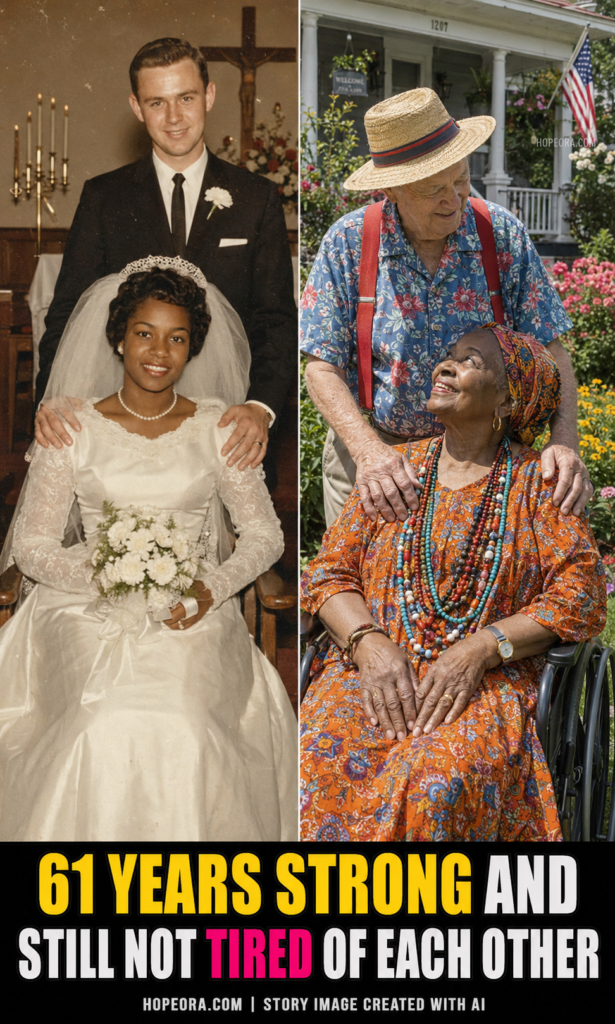
When they married, strangers saw obstacles before they saw a couple in love. Years later, Michael and his wife know their relationship was never defined by other people’s assumptions—it was built through ordinary acts of care repeated every day.
When they signed their marriage papers, people stared.
For some, it was because she is Black.
For others, it was because she uses a wheelchair.
The attention wasn’t new. By the time they exchanged vows, she and Michael had already grown familiar with the lingering glances, the unsolicited opinions, and the questions people seemed to think they were entitled to ask.
Long before their wedding day, others had already formed conclusions about what their future would look like.
Some of Michael’s family worried aloud about the relationship.
His parents questioned whether he was taking on “too much responsibility.”
Friends warned him that his life would become “limited.”
She heard difficult comments as well.
Some people quietly asked whether she was certain she wanted to become what they described as a burden to someone she loved.
The questions came from different directions, but they carried the same underlying assumption: that their relationship would be defined by limitation instead of partnership.
Neither of them accepted that idea.
Instead of trying to convince everyone around them, they focused on something much smaller and much more important.
Each other.
They met at work, where a conversation became another conversation, and then many more. Like countless couples, they spent time getting to know one another before deciding to build a life together.
Their relationship wasn’t built on grand romantic gestures.
It grew through ordinary experiences.
They talked.
They disagreed.
They worked through differences.
Little by little, they learned how to navigate the world together, making practical decisions that reflected both of their lives.
Love, they discovered, often looked far less dramatic than people imagined.
It meant showing up for appointments.
It meant figuring out which entrances had ramps and which did not.
It meant discussing bills, organizing daily responsibilities, and finding solutions together when challenges appeared.
It meant patience.
Not the kind celebrated in movies or dramatic speeches, but the quieter kind that appears in everyday routines and thoughtful choices.
When they eventually married, the ceremony reflected the relationship they had built.
It was simple.
It was genuine.
Most importantly, it belonged to them.
Their wedding was not an attempt to answer critics or silence strangers.
It marked the beginning of a marriage they had already been choosing through countless ordinary decisions.
Life after the wedding did not suddenly become easier.
Marriage did not erase practical challenges or change the way some people viewed them.
Instead, something else happened.
Life became fuller.
The years brought change, just as they do for every family.
Jobs evolved.
Their bodies changed with time.
Children grew up.
Eventually, grandchildren arrived, bringing with them new routines, new celebrations, and new reasons to gather together.
The life that some people once doubted would even begin continued to grow, year after year.
Looking back now, they notice something else has changed.
People do not stare as often.
Perhaps it is because time has passed.
Perhaps it is because familiarity replaces curiosity.
Or perhaps it is because what people see now is no longer a collection of assumptions but the visible result of decades spent building a home and a shared life.
What stands before them is not a prediction.
It is a family.
For all the milestones they have experienced, some of the moments they treasure most remain wonderfully ordinary.
Every morning, Michael brings her a cup of coffee.
Every morning, he forgets the sugar.
And every morning, she reminds him.
It is a small exchange, repeated so many times that it has become part of the rhythm of their days.
To someone passing by, it might seem insignificant.
To them, it represents something much larger.
Long-lasting love is rarely defined by extraordinary moments alone.
More often, it is found in familiar routines, gentle reminders, shared responsibilities, and the comfort of knowing another person continues to show up.
Their marriage has never been about creating a perfect life.
It has been about creating a life that works for them.
One conversation at a time.
One practical decision at a time.
One morning coffee at a time.
Looking back, they do not spend much energy thinking about the predictions that surrounded them in the beginning.
Those opinions have become far less important than the years they have shared together.
The home they built.
The family they watched grow.
The ordinary days that accumulated into an extraordinary life.
They never set out to become symbols or to prove critics wrong.
They simply continued making the next loving choice in front of them.
That quiet consistency became stronger than any assumption others made about who they were or what their future could hold.
In the end, their story is not about the stares they received when they signed their marriage papers.
It is about everything that came afterward.
A partnership shaped by patience.
A family that grew over time.
A home filled with familiar routines.
And two people who, despite every expectation placed upon them, kept choosing each other—day after day, year after year.
What everyday act of kindness has become the quiet foundation of an important relationship in your life?