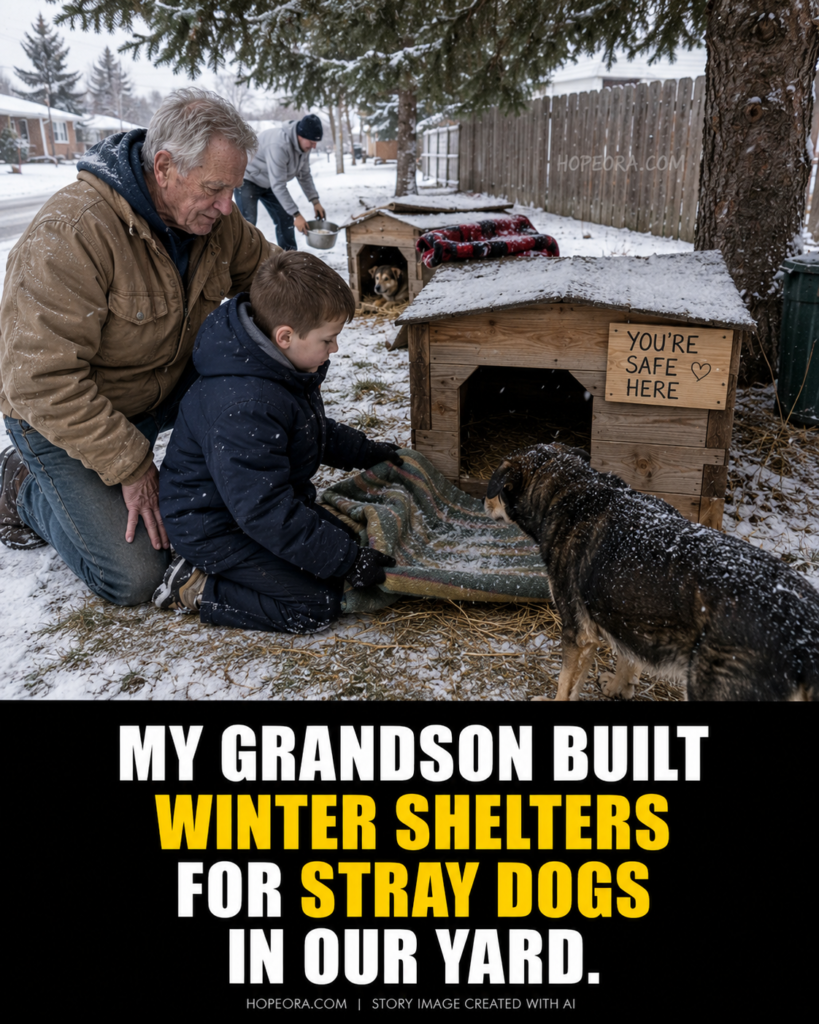
Instead of asking for toys or more screen time, 10-year-old Owen came to his grandfather with a different idea. Together, they built simple shelters for stray dogs, proving that one small act of kindness can make a real difference.
Some of the most meaningful projects don’t begin with blueprints.
They begin with a child asking a simple question and refusing to ignore a problem that others have learned to overlook.
For Paul, that moment came when his 10-year-old grandson, Owen, looked at the stray dogs that wandered near their yard during a bitter winter and decided something had to be done.
Paul had watched Owen grow up, and none of it surprised him.
Even as a little boy, Owen had always paid attention to animals. While other children hurried from one activity to the next, he noticed the details many people missed. He would leave bowls of water outside on warm days, stop to examine paw prints pressed into fresh snow, and ask questions about the animals he saw around the neighborhood.
His concern wasn’t occasional—it was part of who he was.
As winter settled in, the weather became increasingly harsh.
One cold spell arrived quickly, sending temperatures tumbling almost overnight. The wind sharpened, the ground froze hard, and being outside for long periods became dangerous.
Looking toward the fence, Owen spotted the stray dogs that sometimes passed through the area.
After watching them for a moment, he quietly said, “They won’t make it like this.”
It wasn’t said for attention.
It was simply an honest observation from a child who couldn’t stop thinking about what those animals might face once darkness fell.
Soon afterward, Owen came to his grandfather with an idea.
He didn’t ask for a new toy.
He didn’t ask for another video game or more time in front of a screen.
Instead, he asked if they could build something warm.
For Paul, the request spoke volumes.
He had built many things over the years. Experience had taught him how satisfying it could be to make something useful with his own hands. But this project carried a different kind of purpose.
Together, grandfather and grandson began designing simple tunnel shelters that could offer stray dogs protection from the cold.
The idea was practical rather than elaborate.
The shelters were made to catch sunlight during the day, helping them warm naturally, while their enclosed shape helped retain heat through the colder nighttime hours. The goal wasn’t luxury. It was protection from the wind and freezing temperatures using straightforward materials and thoughtful design.
Working side by side, they measured, assembled, and adjusted each shelter together.
It became more than a building project.
It became time shared between two generations, each contributing something valuable. Paul brought years of experience with tools and construction. Owen brought compassion, determination, and a clear sense of why the work mattered.
As the shelters took shape, neither of them knew exactly how quickly they would be used.
Then came the first night.
The stray dogs found the shelters.
One by one, they went inside.
And they stayed.
For Owen, there was no need for celebration. Seeing the dogs choose the shelters was enough to tell him they were serving their purpose.
For Paul, it was a quiet confirmation that his grandson’s instincts had been right all along.
Later, animal volunteers told them that shelters like these can help reduce the risk of hypothermia during freezing weather by giving dogs protection from wind and helping them conserve body heat.
Their simple idea had become something genuinely useful.
The shelters didn’t solve every challenge stray animals face.
They didn’t replace permanent homes, veterinary care, or organized rescue efforts.
But they offered something immediate and important: a safer place to rest through cold winter nights.
Sometimes meaningful change begins with exactly that—a practical response to a problem close enough to see.
For Paul, the project left a lasting impression that reached far beyond the shelters themselves.
He had spent a lifetime building things.
Projects had come and gone over the years, each leaving behind something tangible. But this experience reminded him that the most valuable things adults can help build are often found in the next generation.
Skills can be taught.
So can kindness.
Watching Owen choose compassion over convenience became its own reward.
There was something deeply encouraging about seeing a child respond to suffering not with helplessness, but with action. Instead of assuming someone else would solve the problem, Owen asked what he could do himself—and then invited his grandfather to help.
That spirit turned a simple backyard project into something much larger.
The shelters became a reflection of empathy translated into action.
They showed that caring isn’t measured by age, wealth, or recognition. Sometimes it begins with noticing what others overlook and deciding that even a small effort is worthwhile.
Paul will likely build many more things in his lifetime.
There will always be another repair to make, another project waiting in the workshop, another reason to pick up a hammer.
But this is the one he knows he’ll remember.
Not because of the wood or the design.
Not because of the finished shelters standing in the yard.
He’ll remember it because of the young boy standing beside him—the grandson who saw vulnerable animals shivering in the cold and believed they deserved a warm place to sleep.
Watching that compassion take shape, board by board, filled Paul with a kind of pride that can’t be measured by anything they built.
Some structures protect from the weather.
Others remind us what kindness looks like when it becomes action.
Together, grandfather and grandson created a little of both.
Reader Invitation:
Has a child in your life ever inspired you to see the world differently through a simple act of kindness? We’d love to hear your story.