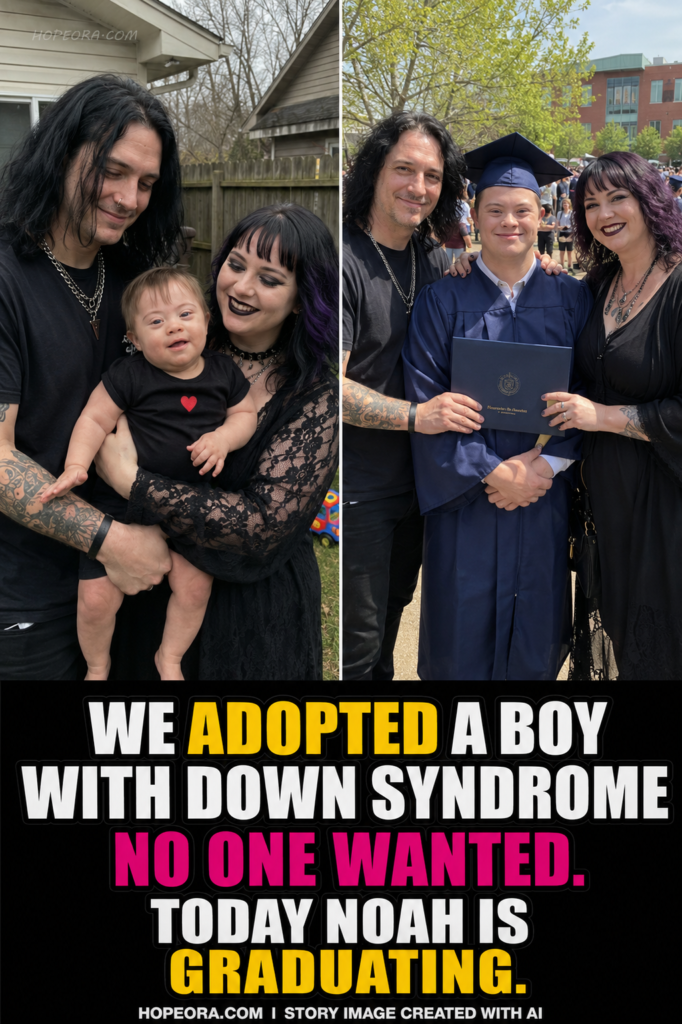
When people questioned whether two young goth teens could raise a child, they focused on appearances instead of commitment. Years later, their son stood proudly holding his diploma, offering a quiet answer to every doubt.
“Goth teens shouldn’t be raising a baby.”
The comment came from a teacher shortly after Jack and I began telling people we wanted to adopt.
It wasn’t the only skeptical reaction we received, but it was the one that stayed with me the longest. It reduced us to the way we dressed and the fact that we were young, as though those two things alone could predict the kind of parents we would become.
Yes, we were young.
We wore black almost every day. We listened to music people associated with rebellion, expressed ourselves differently from our classmates, and didn’t fit many people’s picture of what future parents were supposed to look like.
But we weren’t treating adoption like an impulse or a statement.
We were serious.
The decision had grown slowly, shaped by something much bigger than ourselves. I kept reading articles about children waiting in the adoption system. Story after story described young lives spent moving between placements or waiting months—sometimes years—for someone to choose them.
One pattern was impossible to ignore.
Babies with Down syndrome often had far fewer prospective adoptive families.
Some profiles remained active far longer than others. They were frequently accompanied by clinical descriptions, long lists of anticipated needs, and reminders of future challenges.
The more I learned, the more one thought stayed with me.
No child should grow up believing they were everyone’s last choice.
That idea was heartbreaking.
It wasn’t simply about statistics or waiting lists. It was about the possibility that a child could spend their earliest years surrounded by paperwork describing obstacles instead of people describing possibilities.
When Jack and I talked about it, we kept coming back to the same conclusion.
If we were going to become parents, we wanted to give a child what every child deserves: a family that chose them wholeheartedly.
Eventually, we visited the adoption house.
Among the files we were shown was one for a little boy named Noah.
The language was striking.
“Hard to place.”
“Needs extra support.”
The pages contained careful assessments and practical considerations. Those details mattered, of course. Raising any child comes with responsibilities, and additional support needs deserve honest discussion.
Still, something felt missing.
There was plenty written about what Noah might require.
Very little described who he was.
Then we met him.
He was tiny.
Calm.
His eyes moved thoughtfully around the room, quietly taking everything in as if he were trying to understand this new place and the people standing before him.
There wasn’t a dramatic moment.
No overwhelming rush of fear.
No sudden uncertainty.
Instead, I felt something unexpectedly simple.
Certainty.
The labels disappeared.
The warnings faded into the background.
I wasn’t looking at a case file anymore.
I was looking at our son.
We said yes.
That decision wasn’t the end of the journey—it was the beginning.
We understood that love alone wouldn’t answer every question. We had responsibilities, and we wanted to meet them well.
So we learned.
We read books.
We attended appointments.
We asked questions we didn’t yet know how to answer.
We learned about therapies, daily routines, developmental milestones, educational planning, and the importance of advocating for Noah as he grew. We attended school meetings, listened to professionals, celebrated progress, adjusted expectations when necessary, and continued learning year after year.
Parenthood wasn’t about proving anyone wrong.
It was about showing up.
Again and again.
Like countless families, we discovered that raising a child isn’t defined by one life-changing decision but by thousands of ordinary ones. Early mornings. Bedtime routines. Encouraging words after difficult days. Celebrating small victories that gradually become big ones.
Those quiet moments became the foundation of our family.
Over time, the comments about our appearance mattered less and less.
We were still unmistakably ourselves.
We still dressed the way we liked.
We still heard the occasional assumption from people who judged us before getting to know us.
But the people who mattered most saw something different.
They saw parents.
Today, Noah is graduating.
He’s standing proudly with his diploma in his hands, smiling in our direction.
The years between that first meeting and this milestone are filled with memories no photograph could completely capture. There were lessons learned together, challenges worked through one step at a time, and celebrations that reflected not perfection but perseverance.
Watching him smile, it’s difficult not to think back to those early days.
Back to the file that emphasized how difficult it might be to find him a family.
Back to the warnings that occupied so much space on the page.
Back to the teacher who doubted two young goth teens could raise a child.
None of those voices could have imagined this moment.
The diploma Noah holds represents more than academic achievement. It reflects years of effort from a young man who has grown into himself with determination and support. It also reflects the countless everyday choices that build a family—not dramatic gestures, but consistency, patience, and love expressed over time.
People often make quick judgments based on appearances.
A hairstyle.
Dark clothing.
A first impression.
It’s easy to assume those details tell you everything about someone’s character or capacity.
They don’t.
Parenthood has never depended on fitting a particular image. It isn’t measured by fashion, age alone, or whether someone matches another person’s expectations. It’s measured over years through commitment, responsibility, and the willingness to keep showing up for someone who depends on you.
Looking at Noah today, we don’t see a child who was once described as “hard to place.”
We see the son who transformed our lives every bit as much as we hoped to transform his.
And when we stand beside him for graduation photos, dressed much the way we always have been, we can’t help but smile at how life unfolded.
We were “goth teens” then.
We’re his goth parents now.
And we wouldn’t change a thing.
Have you ever seen someone prove that compassion and commitment matter far more than first impressions? We’d love to hear your story in the comments.