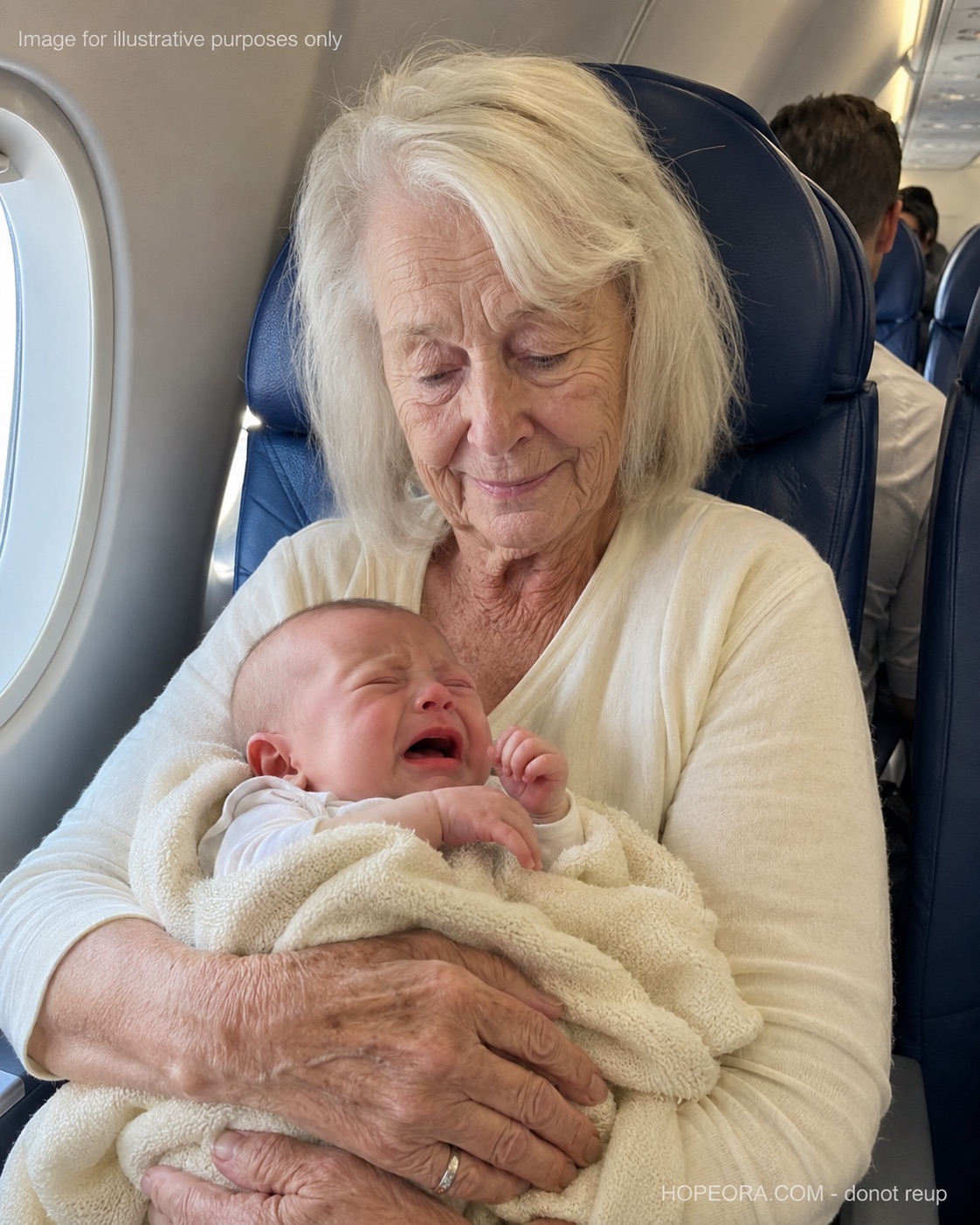
Grief has a way of changing the meaning of ordinary moments. Things that once seemed simple—buying groceries, paying bills, taking a trip across the country—can suddenly feel like mountains to climb. And when you’re carrying not only your own heartbreak but also the responsibility of caring for someone who depends entirely on you, every day becomes an act of quiet courage.
Most people never notice those silent battles. They see only the tired face, the worn clothes, or the crying baby in the grocery store. They don’t see the sleepless nights, the sacrifices hidden behind every smile, or the promises made to loved ones who are no longer here.
I learned that truth at 65 years old, somewhere between takeoff and landing on an ordinary commercial flight.
What began as a journey I hoped would bring a little rest became one of the most humiliating experiences of my life. A single passenger’s harsh words left me questioning my dignity in front of an entire cabin full of strangers. Yet before that flight was over, another stranger—someone decades younger than me—reminded me that compassion still exists in a world that often feels rushed and indifferent.
Looking back now, I realize the flight wasn’t simply about a crying baby or an angry passenger. It became a lesson about the choices people make when confronted with another person’s pain. Some choose impatience. Others choose kindness.
And sometimes, one small act of kindness is powerful enough to restore a heart that has nearly forgotten how to hope.
Across generations, grandparents have often stepped into unexpected parenting roles when life takes unimaginable turns. Few imagine beginning retirement with midnight feedings, diaper changes, and pediatric appointments instead of quiet mornings and well-earned rest. Yet countless older adults willingly shoulder those responsibilities because love leaves them no other choice.
The transition isn’t easy. Fixed incomes stretch thinner with every growing expense, energy becomes harder to replenish, and grief rarely pauses long enough to let healing begin. Still, many grandparents quietly devote themselves to children who need stability, believing that family is built not by convenience but by commitment.
My own story became one of those unexpected journeys.
Only a year earlier, I had imagined spending my retirement tending my small garden, meeting old friends for coffee, and enjoying occasional visits with my daughter as she began raising a family of her own. Instead, life handed me a future I could never have prepared for—a future filled with sorrow, responsibility, and a tiny little girl who needed someone to love her more than ever.
Her name was Lily.
There are moments in life that divide everything into “before” and “after.” For me, that moment came in a hospital room where joy and heartbreak arrived only hours apart.
My daughter had dreamed about becoming a mother for years. Throughout her pregnancy, she talked endlessly about the future, laughing as she imagined first birthdays, bedtime stories, and family vacations. Every visit to my house ended with another excited update about the baby. She had already chosen nursery colors, folded tiny clothes into neat little drawers, and spent evenings reading parenting books with the kind of enthusiasm only an expectant mother can have.
She had even settled on a name months before her due date.
“Lily,” she told me one afternoon as we sat together on my porch, watching the breeze stir the flowers in my garden.
“It’s simple,” she said with a smile. “Soft, but strong. I want her to grow into someone who’s kind no matter what life throws at her.”
I smiled and teased her for already imagining the personality of a baby who hadn’t even arrived yet.
She only laughed.
“I know she’ll surprise me,” she admitted. “But I hope she’ll always know she’s loved.”
Those words stayed with me long after she was gone.
The delivery was supposed to be routine. Doctors assured us everything looked healthy. Family members waited anxiously for good news, expecting to celebrate the arrival of a beautiful little girl.
Instead, our world shattered.
Complications developed so quickly that none of us fully understood what was happening until it was already too late. The medical team fought desperately to save my daughter, but despite every effort, her body simply couldn’t recover.
One moment I was waiting to hear my granddaughter’s first cry.
Next, I was saying goodbye to my only child.
There are no words that truly capture the silence that follows such news. The hospital corridors suddenly seemed too bright, too cold, too empty. I remember hearing conversations around me without understanding a single sentence. Nurses moved quietly through the hallways while doctors spoke gently, but everything sounded distant, as though I had slipped underwater.
In the middle of that overwhelming grief was a tiny newborn girl who knew nothing of the tragedy that had just unfolded.
She slept peacefully, wrapped in a pink blanket, completely unaware that the person who had carried her for nine months would never get the chance to hold her.
I stood beside her bassinet for what felt like hours.
She looked so much like my daughter around the eyes that it almost hurt to look at her.
Then I heard footsteps behind me.
It was Lily’s father.
He walked slowly into the room carrying the weight of shock on his shoulders. His face was pale, his movements uncertain. Without saying a word, he leaned over the bassinet and gently lifted his daughter into his arms.
For several minutes, he simply stared at her.
His hands trembled as he brushed a finger across her tiny cheek.
He whispered something so softly I couldn’t hear it.
Then, with heartbreaking care, he laid her back in the bassinet, tucked the blanket around her, and quietly walked out of the room.
At the time, I believed he simply needed a moment alone.
I wanted to believe that.
The following morning, however, he was gone.
No phone call.
No goodbye.
No explanation spoken face to face.
Only a folded handwritten note resting on the chair beside the hospital bed.
With shaking hands, I unfolded it.
The words were painfully short.
He wrote that he wasn’t strong enough for this life. He couldn’t face raising a child alone after losing his wife. He believed Lily would be better off with me because I would know what to do.
That was the last time I ever heard from him.
I read the note over and over, hoping another explanation would somehow appear between the lines. It never did.
Anger came first.
Then disbelief.
Eventually, only sadness remained.
I couldn’t understand how someone could walk away from a child who had already lost so much before taking her very first breath. Yet as devastated as I felt, I didn’t have the luxury of falling apart.
There was a baby who needed to be fed.
A funeral that had to be arranged.
Paperwork to complete.
Tiny clothes to wash.
Life refused to pause for grief.
So, with trembling hands and a broken heart, I carried my granddaughter home.
The house felt painfully quiet without my daughter. Every room held memories of her laughter, her dreams, and the future she’d imagined. Now, instead of preparing for visits from a proud new mother, I found myself setting up a crib in the spare bedroom and learning once again how to care for a newborn.
The first night was the hardest.
Lily cried every couple of hours, just as healthy babies do. I walked the floors long after midnight, gently rocking her while exhaustion settled into my bones.
Sometimes I caught myself whispering the same lullabies I had once sung to my own daughter decades earlier.
Those songs carried both comfort and heartbreak.
As Lily slowly drifted to sleep against my shoulder, tears slipped silently down my face.
“I promised your mommy I’d always be here,” I whispered into the quiet darkness. “And I promise I’ll be here for you, too.”
I didn’t know exactly how I would keep that promise.
I only knew that I had to.
Story (Continued)
The weeks that followed settled into a rhythm I never expected to experience again at my age.
My mornings began before sunrise. Lily would wake hungry, her tiny cries echoing through the quiet house, and I’d shuffle into her room with sleepy eyes and aching joints. After feeding her, I’d rock her gently by the window until the first rays of sunlight spilled across the floor. Sometimes she would fall asleep against my shoulder, her warm little body relaxing completely in my arms, and I’d linger there a few extra minutes, soaking in the peaceful silence before another busy day began.
Retirement no longer resembled anything I had imagined.
Instead of leisurely afternoons or weekend outings with friends, my calendar revolved around doctor’s appointments, grocery lists, diaper changes, and carefully planned budgets. Every dollar had a purpose before it even reached my bank account.
Living on a pension was difficult enough for one person.
Raising a baby made it feel nearly impossible.
The cost of formula, diapers, baby wipes, and growing clothes seemed endless. Just when I thought I had finally caught up, another expense would appear. A visit to the pediatrician. A new car seat. A box of diapers one size larger because Lily had suddenly outgrown the last package.
More than once, I stood in the grocery store comparing prices for several minutes, calculating every penny in my head before placing an item into the cart.
I stretched my pension as far as it would go, but it was never quite enough.
So I found little ways to earn extra money.
I babysat for neighbors whenever they needed an evening out. I helped organize donations at the local church food pantry, where volunteers often insisted I take home groceries that otherwise might have gone to waste. Occasionally, I mended clothes or did simple sewing jobs for people in the neighborhood.
None of it paid very much.
But together, those small jobs kept food on our table and Lily’s nursery stocked with the essentials she needed.
Every night, after finally settling her into her crib, I sat alone at my kitchen table with a calculator, stacks of bills, and a notebook filled with careful figures.
Sometimes the numbers simply refused to cooperate.
I’d rub my tired eyes and wonder how another month had disappeared so quickly.
Then, from the bedroom, I’d hear Lily stir.
Just a soft sigh.
A tiny coo.
The gentle rustle of blankets.
I’d walk into her room, and she’d look up at me with those wide, curious eyes that reminded me so much of my daughter.
In those moments, every worry faded.
She had already lost more than any child ever should.
She deserved one person who would never leave.
That promise became my strength.
Months passed, and although life remained exhausting, Lily slowly transformed from a sleepy newborn into an alert, smiling little girl who watched everything around her with endless curiosity.
Her laughter became the brightest sound in the house.
It filled rooms that grief had once emptied.
Whenever she smiled, I caught glimpses of the daughter I missed every single day. Not because Lily replaced her mother—no one ever could—but because love has a remarkable way of continuing through generations.
It was enough to keep me going.
Then, one afternoon, my oldest friend called.
Carol and I had known each other for nearly forty years. We’d raised our children together, celebrated birthdays, comforted one another through illnesses, and remained close despite eventually living on opposite sides of the country.
She had checked on me often after my daughter’s passing, but this time, there was a firmness in her voice.
“Margaret,” she said gently, “I’m worried about you.”
“I’m alright,” I answered automatically.
She laughed softly.
“No, you’re surviving. That’s different.”
I didn’t argue.
Perhaps because I knew she was right.
She continued, “Come visit me for a week.”
“I couldn’t.”
“Why not?”
“You know why.”
“The money?”
“That’s part of it.”
“And the other part?”
I looked toward Lily, who was peacefully sleeping in her crib nearby.
“I can’t travel alone with a baby.”
“You won’t be alone once you get here,” Carol replied immediately. “Bring Lily. I’ll help with everything. We’ll take turns feeding her at night. You can sleep for once.”
Sleep.
The word itself sounded almost luxurious.
I honestly couldn’t remember the last time I’d enjoyed a full night’s rest.
“You deserve a break,” Carol continued. “Even strong people need someone to lean on.”
Her words stayed with me long after the conversation ended.
For days, I debated whether I should go.
Every practical reason told me to stay home.
The tickets cost money.
Traveling with an infant would be difficult.
There would always be another bill waiting to be paid.
Yet another part of me quietly admitted something I had been avoiding for months.
I was exhausted.
Not simply physically.
Emotionally.
Mentally.
Spiritually.
Grief and responsibility had become constant companions, leaving almost no room to breathe.
Maybe Carol was right.
Maybe accepting help wasn’t weakness.
Maybe it was necessary.
Over the next several weeks, I saved every extra dollar I could.
I skipped little comforts.
I postponed buying new clothes for myself.
I picked up a few additional odd jobs whenever neighbors called.
Little by little, I managed to save enough for the least expensive airline ticket I could find.
Economy class.
No extras.
Just a seat that would get Lily and me safely across the country.
The morning of our flight arrived sooner than I expected.
Long before dawn, I carefully packed Lily’s diaper bag, double-checking every pocket to make sure I hadn’t forgotten anything.
Diapers.
Formula.
Extra bottles.
Pacifiers.
Blankets.
A change of clothes.
Baby wipes.
Her favorite soft toy.
Each item felt essential.
Traveling with a baby meant preparing for every possible situation, even those you hoped would never happen.
Before leaving the house, I paused in the hallway.
The framed photograph of my daughter smiled back at me from the table near the front door.
She looked so young.
So hopeful.
I touched the edge of the frame.
“We’re going to be okay,” I whispered quietly.
“I’m trying.”
With Lily secured safely against my chest, I locked the front door and headed for the airport.
Everything felt overwhelming from the moment we arrived.
The terminal buzzed with hurried travelers dragging rolling suitcases behind them.
Announcements echoed overhead.
Children laughed.
Business travelers hurried past while staring at their phones.
Families clustered around departure boards.
I held Lily close, navigating security lines with one hand while balancing our bags with the other.
By the time we finally reached our gate, I already felt tired.
Still, I reminded myself why we were making the trip.
Carol was waiting.
A week of friendship, support, and perhaps a little rest lay on the other side of this flight.
That thought carried me through boarding.
Our seats were near the back of the plane.
The aisle was narrow, and the overhead bins filled quickly as passengers squeezed past one another.
I apologized several times while adjusting the diaper bag and settling carefully into our seats.
Around us, travelers prepared for the flight in familiar ways.
Some immediately opened laptops.
Others slipped on headphones.
A few leaned back and closed their eyes before the plane had even pushed away from the gate.
I glanced down at Lily.
She looked peaceful.
Her tiny fingers rested against my sweater, and for a brief moment I allowed myself to believe we might actually have an uneventful flight.
I silently thanked heaven.
Maybe we’d be lucky.
Maybe she’d sleep through most of the journey.
But just as the engines roared louder and the aircraft began climbing into the sky, Lily stirred.
First came a small whimper.
Then another.
I gently rocked her.
“It’s alright, sweetheart,” I whispered.
She fussed again.
Within minutes, the soft sounds became full, desperate cries.
I immediately reached for her bottle.
She turned her head away.
I checked her diaper as discreetly as I could in the cramped seat.
It was dry.
I bounced her gently against my shoulder while humming the lullaby my daughter had loved as a little girl.
Nothing worked.
Instead, Lily cried harder.
Each sob echoed through the crowded cabin.
I could almost feel dozens of strangers becoming aware of us.
One by one, heads began to turn.
Some passengers simply glanced before looking away again.
Others weren’t nearly as subtle.
The woman seated across the aisle sighed dramatically.
A man several rows ahead twisted around in his seat with obvious irritation written across his face.
Another passenger muttered something under his breath before pulling his headphones tighter over his ears.
With every passing minute, my embarrassment deepened.
My face burned.
I continued whispering reassuring words to Lily, though I wasn’t sure whether I was trying harder to comfort her or myself.
“It’s okay,” I murmured. “Grandma’s here.”
She cried on.
I kissed the top of her head.
Rocked her.
Patted her back.
Adjusted the blanket.
Tried the bottle again.
Nothing eased her distress.
The cabin suddenly felt much smaller than it really was.
Every cry seemed louder than the one before.
Every second stretched endlessly.
I lowered my eyes, wishing I could somehow make us invisible.
Then I sensed movement beside me.
The man seated next to us shifted impatiently in his chair once again.
He rubbed his temples with visible frustration, let out a long, irritated breath, and turned slowly toward me.
His expression told me exactly what was coming.
Before he even opened his mouth, my stomach tightened with dread.
“For God’s sake, can you shut that baby up?”
His voice cut through the cabin so sharply that conversations stopped around us.
For a moment, I couldn’t even respond.
I stared at him, my heart pounding, as Lily continued crying against my shoulder. Every instinct told me to comfort her, but his words left me frozen.
“I… I’m trying,” I managed to whisper.
He leaned closer, his face twisted with irritation.
“Trying?” he scoffed. “Your efforts clearly aren’t enough. I paid good money for this seat, and I didn’t pay to spend the entire flight listening to a screaming child.”
My cheeks burned with humiliation.
“I’m so sorry,” I said quietly. “She’s just a baby. I don’t know what’s upsetting her.”
“The rest of us shouldn’t have to suffer because of it,” he snapped. “Take her somewhere else. Go stand in the galley. Lock yourself in the restroom if you have to. I don’t care where you go, but as long as she’s crying, don’t come back.”
His words landed harder than I expected.
It wasn’t simply the anger in his voice.
It was the complete absence of compassion.
He wasn’t looking at an exhausted grandmother struggling to soothe a frightened infant. He saw only an inconvenience standing between him and a peaceful flight.
Around us, the cabin remained painfully quiet.
A few passengers lowered their eyes.
Others pretended not to notice.
No one said a word.
My vision blurred with tears.
The last thing I wanted was to disturb anyone. I had spent nearly an hour doing everything I could think of to comfort Lily, and nothing had worked.
Perhaps leaving really was the only option.
With trembling hands, I gathered the diaper bag and slowly rose from my seat.
“I’m sorry,” I whispered once more.
Holding Lily close against my chest, I stepped into the narrow aisle.
Each step felt heavier than the last.
I could feel dozens of eyes following me as I walked toward the back of the plane.
I kept my head down, blinking away tears that refused to stop falling.
Humiliation has a strange weight.
It settles quietly on your shoulders until even standing upright becomes difficult.
Then, just before I reached the restroom, I heard a calm, gentle voice.
“Ma’am?”
I stopped.
Turning slowly, I saw a teenage boy standing several rows ahead.
He couldn’t have been more than sixteen years old.
Unlike everyone else, he wasn’t looking at me with annoyance or pity.
He was smiling kindly.
“Please wait,” he said.
His voice carried none of the impatience that had filled the cabin only moments earlier.
“You don’t need to go back there.”
Something remarkable happened at that exact moment.
As though Lily had sensed the gentleness in his voice, her cries softened.
The loud sobs became quiet whimpers.
Then they disappeared altogether.
Silence.
The sudden quiet felt almost unbelievable after nearly an hour of constant crying.
Lily opened her eyes.
Instead of reaching toward me, she stretched out one tiny hand toward the young man standing in the aisle.
He smiled even wider.
“See?” he said softly. “She’s tired. I think she just needed everyone to calm down.”
He reached into his pocket and held out his boarding pass.
“I’m sitting in business class with my parents,” he explained. “Please take my seat.”
I stared at him in disbelief.
“Oh, sweetheart,” I said, shaking my head. “I couldn’t possibly do that.”
“You can.”
“You belong with your family.”
“My parents will understand.”
“I can’t take something so generous.”
He smiled again.
“I want you to.”
There wasn’t the slightest hesitation in his voice.
Only sincerity.
Before I could object again, he added quietly, “My parents taught me that when someone needs help, you help them.”
Those simple words dissolved the last of my resistance.
I nodded, unable to speak through my tears.
“Thank you,” I whispered.
“No,” he replied gently.
“I think you need this more than I do.”
He stepped aside, allowing me to walk toward the front of the aircraft.
As I entered the business-class cabin, two people immediately stood to greet me.
The boy’s parents.
His mother welcomed me with the warmest smile I’d seen in months.
“Please,” she said softly. “Sit down and make yourself comfortable.”
Her husband motioned to a flight attendant.
“Could we have an extra pillow and a blanket for the baby?”
Within moments, someone arrived with both.
I carefully settled into the wide leather seat.
The difference was astonishing.
There was room to breathe.
Room to move.
Most importantly, there was peace.
I laid Lily gently across my lap.
She sighed deeply, accepted her bottle without hesitation, and began drinking quietly.
Within minutes, she drifted into a peaceful sleep.
I looked down at her tiny face.
Then I looked toward the teenage boy, who was already walking back toward economy class.
Tears rolled silently down my cheeks.
Not tears of shame this time.
Tears of gratitude.
I leaned down and kissed Lily’s forehead.
“There are still good people in this world,” I whispered.
“I hope you always remember that.”
I thought the story had ended there.
I was wrong.
The teenage boy quietly returned to economy class.
Without complaint, he slipped into my old seat beside the same man who had demanded I leave.
At first, the man looked delighted.
He leaned back comfortably and muttered loud enough for nearby passengers to hear, “Finally. Now we can have a peaceful flight.”
Then he turned to greet his new seatmate.
The satisfaction disappeared from his face instantly.
He recognized the boy.
“So… you’re on this flight?” the man asked awkwardly.
The teenager nodded.
“I am.”
“I didn’t realize.”
“I heard everything you said to that grandmother.”
The man’s smile faltered.
“It wasn’t what it looked like.”
“I think it was exactly what it looked like.”
The cabin grew very quiet once again.
“My parents always tell me something,” the boy continued calmly.
“They say you learn who people really are by watching how they treat someone who has nothing to offer them.”
The man swallowed hard.
“That woman was doing everything she could.”
“I know.”
“Babies cry.”
“I know.”
“You didn’t help.”
The man shifted uncomfortably.
“You humiliated her.”
“I…”
“You chose cruelty when kindness would have cost you nothing.”
The man attempted a nervous laugh.
“You don’t understand. That baby cried for nearly an hour.”
The teenager met his eyes steadily.
“That grandmother has probably been carrying far heavier burdens than one difficult flight.”
The rest of the journey passed in complete silence.
The man barely spoke another word.
After landing, passengers slowly gathered their belongings and made their way toward the terminal.
I thanked the family again before we left the aircraft.
The teenage boy simply smiled.
“I’m glad Lily is sleeping,” he said.
“So am I.”
At baggage claim, I noticed the boy speaking quietly with his parents.
His father listened carefully while his son described everything that had happened in economy class.
The more he heard, the more serious his expression became.
Only later did I learn why.
The man who had shouted at me wasn’t just another passenger.
He worked for the boy’s father.
The teenager’s father was his employer.
Near the baggage carousel, the businessman approached his employee.
They stepped aside for a private conversation.
I couldn’t hear every word.
I didn’t want to.
Some conversations deserve their privacy.
Still, I could read enough from their expressions.
The employee’s confidence disappeared.
His shoulders sagged.
His face grew pale.
When the conversation ended, he walked away looking utterly defeated.
A few minutes later, the boy’s mother approached me.
“I thought you should know,” she said gently.
“My husband told him that someone who could treat an elderly grandmother and a helpless baby with such cruelty didn’t reflect the values of our company.”
She paused.
“He won’t be working with us anymore.”
For a long moment, I didn’t know what to say.
Surprisingly, I felt no satisfaction.
No triumph.
No desire for revenge.
Only a quiet sense that actions carry consequences.
His future hadn’t been ruined by a crying baby.
It had been shaped by his own choices.
That realization stayed with me long after the flight ended.
When Carol welcomed Lily and me into her home later that evening, she wrapped me in a hug before I could even put my suitcase down.
“You look exhausted,” she whispered.
I laughed softly through fresh tears.
“I’ve had quite a day.”
Over the next week, I finally rested.
Carol insisted on helping with nighttime feedings.
She cooked warm meals.
She held Lily while I took long naps I hadn’t realized I needed so desperately.
For the first time in months, I wasn’t carrying every responsibility alone.
Yet whenever I thought back to the flight, it wasn’t the cruel passenger who came to mind first.
It was the teenage boy.
One act of impatience had nearly convinced me that I was nothing more than a burden.
One act of kindness restored my faith in people.
Lily will probably never remember that journey.
She’ll never remember crying through takeoff or sleeping peacefully in a business-class seat offered by a stranger.
But I will.
I’ll remember the young man who stood up when everyone else stayed silent.
I’ll remember parents who raised a son to value compassion over comfort.
And I’ll remember that even in life’s darkest seasons, goodness still finds a way to appear when it’s needed most.
Reflection
Life has taught me that grief changes us, but it doesn’t have to harden us.
After losing my daughter, I often felt invisible. I was no longer simply a mother or a grandmother. I became an older woman trying to stretch a pension, raise an infant, and rebuild a future I had never imagined. Many days, I wondered whether anyone truly saw how hard I was trying.
That flight reminded me that people make choices every day about how they respond to another person’s struggle.
Some see inconvenience.
Others see humanity.
The difference isn’t found in wealth, education, or age. It’s found in the willingness to pause before judging someone whose story we don’t know.
The teenage boy didn’t know everything I had endured. He didn’t know about my daughter’s death, Lily’s father walking away, or the sleepless nights spent wondering how I would pay another month’s bills.
He didn’t need to know.
He saw an exhausted grandmother holding a crying baby, and that was enough.
His kindness didn’t erase my grief, nor did it solve every challenge waiting for me at home. But it reminded me that compassion has a remarkable way of reaching places that words alone cannot.
Sometimes we remember extraordinary achievements.
Sometimes we remember promotions, awards, or milestones.
But just as often, we remember a stranger who offered a seat, a comforting smile, or a helping hand on a difficult day.
Those quiet moments become part of us.
They restore our faith when life has tested it.
And they inspire us to become that same source of comfort for someone else.
Takeaway
Looking back, I no longer think of that day as the flight where my granddaughter wouldn’t stop crying.
I think of it as the day a young stranger reminded me that kindness still has the power to change someone’s entire world.
We never truly know what another person is carrying. A weary face may hide unimaginable grief. A crying child may belong to someone fighting the hardest battle of their life.
Compassion asks very little of us, yet it can leave a lasting mark on someone else’s heart.
Long after the flight ended, I forgot the seat number, the boarding gate, and even the airline.
But I’ll never forget the teenager who stood up for two strangers when it mattered most—or the hope he quietly restored in an aging grandmother who desperately needed to believe that goodness still exists.