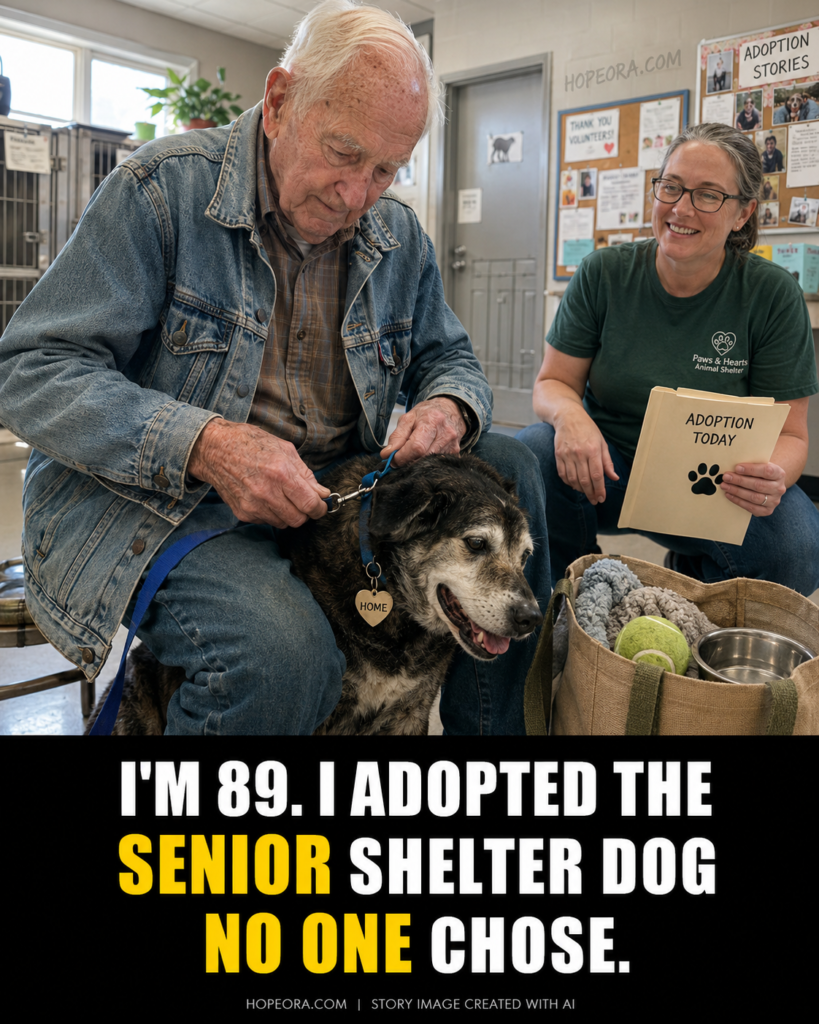
Years after losing his wife, a man walked into an animal shelter searching not for excitement but for companionship. The dog who had waited the longest turned out to be exactly the friend he needed.
The house had been quiet for years.
After his wife passed away, there were no children to fill the rooms with conversation or laughter. The routines they had once shared gradually became solitary ones. Mornings began the same way, evenings ended the same way, and the silence that settled over the home became as familiar as the furniture itself.
For a long time, he simply lived with it.
Then one morning, something shifted.
There wasn’t a dramatic moment or a grand realization. It was simply the feeling that he no longer wanted to spend another day sitting alone with the same silence that had become his constant companion. He wasn’t looking for excitement or distraction. He wasn’t trying to replace the life he had lost.
He was looking for company.
So he drove to the local animal shelter with a purpose.
He wanted someone who understood slower days and quiet nights. Someone who wouldn’t expect endless activity or constant adventure. Someone who, in their own way, might understand what it meant to wait.
The shelter staff introduced him to a dog named Buddy.
Buddy wasn’t the youngest dog there. He wasn’t the one visitors hurried toward first. He had been passed over again and again, watching other dogs leave while he remained behind.
He had become the shelter’s longest resident.
Older dogs often wait longer for homes than playful puppies. Many people are drawn to youth, hoping for years of energetic companionship ahead. But older dogs frequently arrive with something different to offer: patience, gentleness, and a calm presence shaped by experience.
Buddy seemed to embody all of that.
When they met, there was no barking performance or eager jumping to capture attention.
Instead, the man sat quietly on the floor.
Buddy walked over at his own pace.
Then, without hesitation, he leaned gently against the man’s leg.
It was a small gesture, almost understated.
But in that simple moment, it felt as though Buddy already understood why he had come.
There was no need to force a connection.
Neither of them seemed interested in pretending to be anything other than who they already were.
The decision that followed wasn’t rushed.
He signed the adoption papers slowly, taking each step with care. Buddy followed him toward the exit just as carefully, almost as though hope was something that needed to be confirmed before it could be believed.
For Buddy, leaving the shelter meant the end of a long wait.
For the man, it marked the beginning of a different chapter.
The first night at home, Buddy chose to sleep by the door.
Perhaps it was simply where he felt most comfortable. Perhaps every new home takes time to become familiar. Whatever the reason, there was a respectful distance between them as they settled into their new routine together.
On the second night, Buddy moved a little closer.
The space between them had already begun to shrink.
Days turned into weeks, and routines slowly formed without either of them demanding much from the other. There were quiet mornings. Unhurried walks. Evenings spent sharing the same room without needing constant activity to fill the time.
Neither seemed bothered by silence.
In fact, they appeared to understand it.
Now, each evening, Buddy rests his head on the man’s lap.
It’s a habit that arrived naturally, without training or encouragement. It has simply become part of their life together, one small act repeated often enough to become a source of comfort.
There are no grand speeches in moments like these.
No dramatic declarations.
Just the steady reassurance of a warm head resting nearby and the knowledge that someone is there.
Loss changes people.
The absence left by someone deeply loved never disappears entirely, and companionship does not erase grief. Instead, it often changes the shape of everyday life, making ordinary moments feel a little less empty.
That is what Buddy offered.
Not a replacement.
Not a cure.
Simply presence.
Sometimes that’s the greatest gift another living being can provide.
The shelter had seen Buddy overlooked countless times. Visitors had walked past his kennel searching for younger dogs, more energetic dogs, dogs that seemed easier to imagine bringing home.
But the right match isn’t always the loudest or the most obvious.
Sometimes it is built on shared quiet.
One needed a home.
The other needed a friend.
Together, they found exactly what neither could have found alone.
Looking at Buddy now, curled comfortably beside him each evening, it’s difficult to imagine either of them anywhere else.
The house is still quiet.
But it no longer feels empty.
There is the sound of paws crossing the floor, the familiar presence waiting nearby, and the simple comfort of knowing that when the day comes to an end, Buddy will be there, resting his head gently on his lap.
He never wanted more noise.
He only wanted someone who would stay.
And in Buddy, the dog who had waited the longest, he found exactly that.
Reader Invitation:
Have you ever found comfort or healing through the companionship of a pet, especially during a difficult chapter of life? Share your story in the comments.