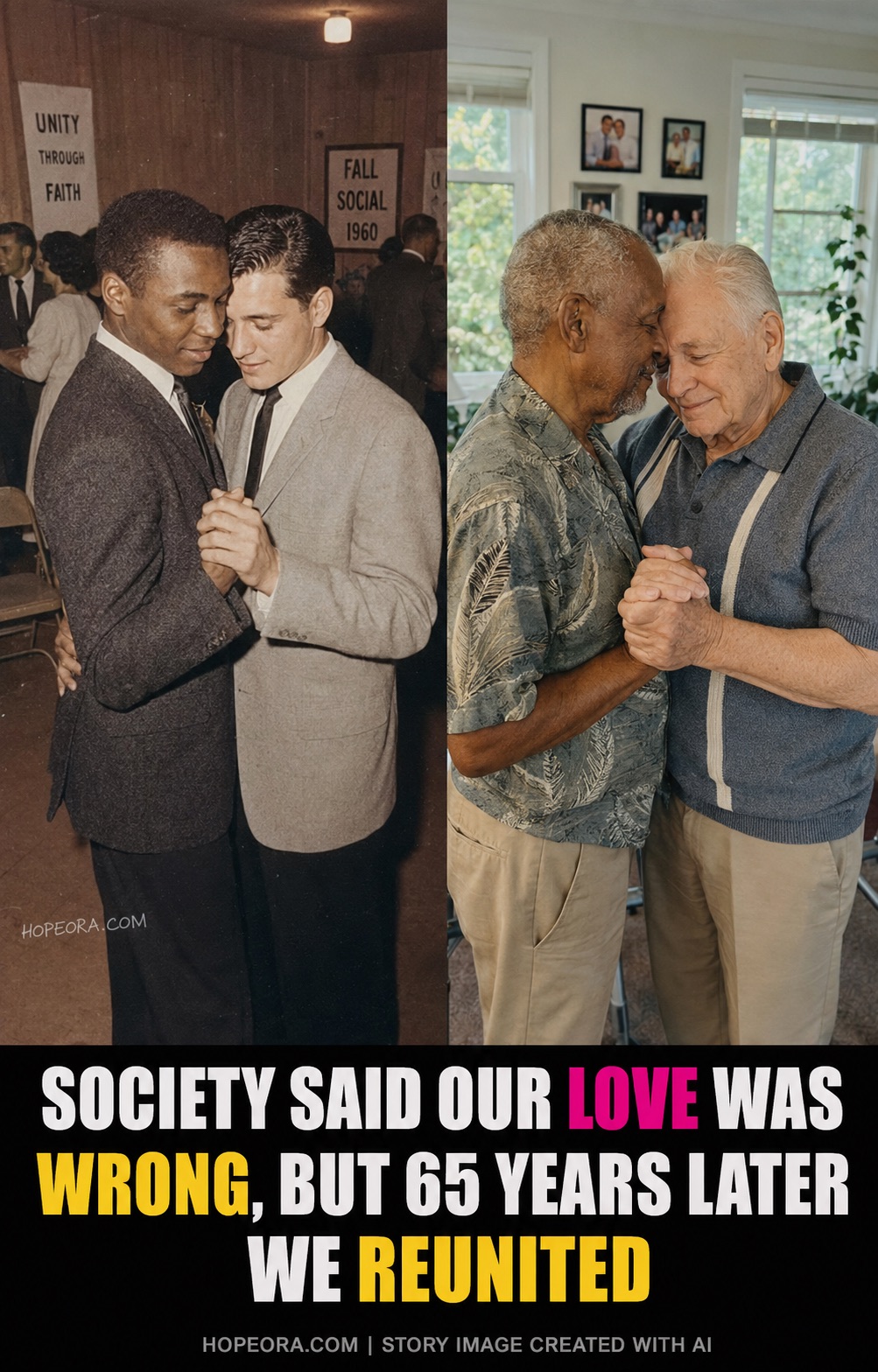
A Love Interrupted, but Never Forgotten
Some people enter our lives quietly, without fanfare, and somehow leave a mark that never fades. Years pass. Careers are built, families grow older, entire generations come and go. Yet one memory can remain as vivid as the day it happened, waiting patiently beneath the surface of everyday life.
For some, college is remembered for football games, late-night studying, or lifelong friendships. For others, it becomes the place where they first discover who they truly are. Sometimes that discovery comes through love—a kind of love that feels both exhilarating and frightening because it asks us to be braver than we have ever been before.
In the mid-1960s, choosing love could also mean choosing conflict. Social expectations were rigid, especially in the American South. Families, neighbors, and even complete strangers often believed they had the right to decide who belonged together and who did not.
This is the story of two young people who met at exactly the right time, were pulled apart by forces far bigger than themselves, and discovered, more than half a century later, that some promises never stop waiting to be fulfilled.
College Beginnings in a Divided Time
It was my first week of college in North Carolina in 1965.
Everything felt new. The campus buzzed with nervous freshmen trying to find classrooms, make friends, and figure out what adulthood might look like. There was excitement in the air, but there was also tension that reflected the times. America was changing, though not everyone welcomed that change. Questions of race, equality, and belonging touched nearly every corner of daily life, especially in the South.
I wasn’t thinking about history when I walked into the student lounge one afternoon.
I was simply looking for a quiet place to study.
Instead, I noticed a small group gathered around a tutoring table. At the center sat James.
He was patiently explaining algebra problems with a calm confidence that immediately drew people in. He never raised his voice. He didn’t need to. His steady manner made complicated equations seem almost simple.
He was also the only Black man in the room.
That fact seemed to matter to everyone else.
To me, he was simply the young man whose gentle smile made an intimidating college campus suddenly feel a little more welcoming.
A Friendship That Became Something More
When the tutoring session ended, students drifted away, gathering their notebooks and rushing toward evening plans.
James stayed behind, stacking textbooks into neat piles.
Without thinking much about it, I walked over and offered to help.
It was a small gesture.
Neither of us could have guessed it would change everything.
As we carried books across the room, conversation came naturally. We talked about classes, professors, hometowns, and why algebra seemed easier for him than for almost anyone else.
Minutes slipped into hours.
Before either of us realized it, midnight had arrived.
That became our rhythm.
James patiently helped me understand math formulas that had always seemed impossible. In return, I showed him a handful of guitar chords I’d learned growing up.
Our lessons rarely stayed focused on math or music for very long.
Instead, they became conversations about dreams, fears, favorite books, and the uncertain future stretching before us.
The more time we spent together, the easier it became to forget that the rest of the world saw us differently.
Finding Places Where No One Knew Our Names
Whenever we could escape campus, we’d drive to a nearby lake.
It wasn’t remarkable because of the scenery, although the water sparkled beautifully beneath the afternoon sun.
It mattered because no one there knew us.
For a few precious hours, we could laugh without wondering who might be watching.
We talked while skipping stones across the water.
Sometimes James played the guitar while I sang softly beside him.
Other afternoons we simply sat in comfortable silence, grateful to exist in a place where our friendship—or perhaps something deeper—didn’t require explanation.
Those quiet moments became our refuge.
Looking back now, I realize how carefully James watched the world around us.
Even while smiling, he noticed passing cars.
Even while laughing, he remained aware of nearby strangers.
I didn’t fully understand why.
He did.
“People Talk”
Reality found us again sooner than either of us wanted.
One afternoon, someone we knew spotted us together.
Later, a friend pulled me aside.
“People talk,” the friend warned.
The words sounded almost casual, but the meaning behind them wasn’t.
Rumors spread quickly on a college campus.
In 1965, they could also become dangerous.
I shrugged it off.
“I don’t care,” I said.
James wasn’t so quick to dismiss the warning.
When we spoke about it later, his expression grew thoughtful.
“We have to be careful,” he told me quietly.
There wasn’t fear in his voice.
There was experience.
He understood consequences that I had never personally faced.
Even then, I don’t think I fully appreciated the weight he carried every single day.
The Day Everything Changed
About a month later, everything unraveled.
My father somehow found a note James had written to me.
It wasn’t dramatic.
It wasn’t scandalous.
It was simply personal.
For my father, that was enough.
He drove three hours to campus without warning.
When he reached my dormitory, his anger filled the hallway before I even opened the door.
“He’s Black,” he shouted.
“And a man.”
Then came the words that echoed in my memory for decades.
“Are you crazy?”
Before I could explain anything, he grabbed my arm and pulled me from the building.
I kept looking back, hoping to catch one last glimpse of James.
I never did.
Soon afterward, I learned he had been fired from his campus job.
I wasn’t given details.
No explanation could have softened the pain anyway.
One day we were planning another trip to the lake.
The next, he was simply gone.
Fifty-Five Years of Silence
Life has a way of continuing even when our hearts aren’t ready.
Years became decades.
The world changed in ways that once seemed impossible.
Laws changed.
Attitudes slowly shifted.
Young couples began living lives that would have shocked many people in 1965.
Still, every now and then, my thoughts returned to James.
I wondered where life had taken him.
Whether he was happy.
Whether he still played guitar.
Whether he ever thought about those afternoons by the lake.
Some questions never completely leave us.
We simply learn to carry them.
A Bench Waiting Through the Years
Fifty-five years later, I returned to campus for a reunion.
The familiar buildings looked older.
So did I.
Walking across those sidewalks felt like opening a long-forgotten photo album.
Then I saw the bench.
And sitting there…
…was James.
For a moment, time folded in on itself.
His hair had turned gray.
His face carried the gentle lines that only decades can draw.
But when he looked up, the smile was unmistakable.
He grinned as though no time had passed at all.
“Took you long enough.”
I laughed through tears I hadn’t expected.
There was nothing left to explain.
No speeches.
No blame.
Only two people who had once been separated by prejudice and circumstance, now sitting together again.
I sat beside him.
Then I answered with the only words that truly mattered.
“Not leaving this time.”
The Quiet Strength of Love
Not every love story follows the path we imagine.
Some are interrupted by fear, by family expectations, or by the injustices of the time in which they begin. The years lost can never be returned, and no reunion can erase the pain of what happened.
Yet there is something deeply moving about love that survives not because it was easy, but because it remained honest. Even after decades apart, the connection between two people can still feel familiar, like a melody remembered after years of silence.
James and I could not change the past. We could not reclaim the birthdays, holidays, and ordinary afternoons that slipped away. But we could choose what came next. Sometimes that choice is the most powerful one we ever make.
Takeaway
History shapes our lives, but it does not have to write the final chapter.
The voices that once insisted two people didn’t belong together eventually grew quieter. What endured instead was kindness, memory, and the courage to return when the opportunity finally came.
Some reunions arrive late. Some apologies are never spoken aloud. And some love stories spend decades waiting for a simple sentence that carries the weight of a lifetime:
“Not leaving this time.”