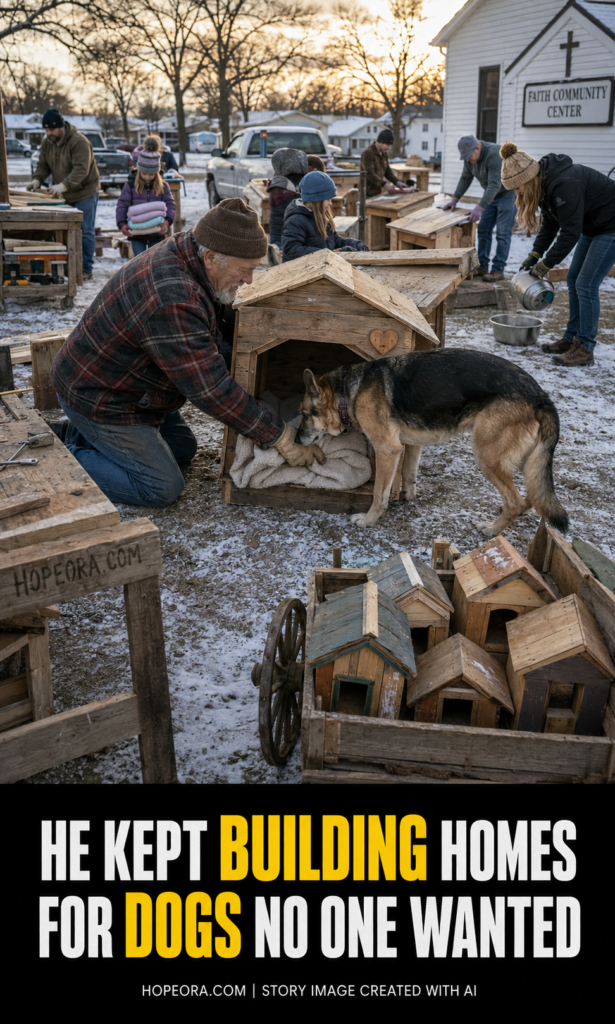
Every Tuesday, 74-year-old Walter drives through his mountain town collecting broken boards and old pallets. What many mistake for scrap becomes something far more meaningful: warm, carefully built shelters for stray dogs facing another cold winter.
On Tuesday mornings, people in Walter’s small mountain town often see the same familiar sight.
The 74-year-old slowly drives along quiet roads with the back of his truck filling up with broken fence boards, worn pallets, and leftover pieces of lumber. To most passersby, it looks like an ordinary cleanup routine. Some assume he’s gathering firewood. Others think he’s simply hauling away debris that no one else wants.
Few realize those discarded pieces are only the beginning of a much larger purpose.
By the afternoon, weathered boards that might have ended up in a landfill have been measured, cut, assembled, and carefully transformed into sturdy little shelters for stray dogs. What once looked like worthless scraps become warm places where an animal can escape freezing winds, snow, and long winter nights.
It’s work Walter repeats week after week without much attention.
For him, that’s exactly how he prefers it.
After spending four decades building homes for people, retirement could have meant setting down his tools for good. Instead, it simply changed who he was building for.
“I spent forty years building houses for people,” Walter says with a smile. “Now I’m building a few for the ones nobody else notices.”
That simple statement captures the heart of his quiet mission.
Years of experience haven’t made him rush through the process. If anything, they’ve made him even more thoughtful about the details. Every shelter is built with the same practical care that once went into larger construction projects.
Each doorway is measured so older dogs won’t have to squeeze through a tight opening. Walter understands that aging animals often move more slowly and don’t have the same flexibility they once did. A few extra inches can make all the difference.
As temperatures begin to fall, he adds additional insulation before the first snowfall arrives. It’s a small step that can help the shelters hold warmth longer during cold nights.
Even the finishing touches are intentional.
Rather than leaving every shelter looking the same, Walter paints each one a different color. The bright finishes add a cheerful touch to neighborhoods that might otherwise overlook the dogs living nearby. They also serve a practical purpose: local children can easily remember which dogs sleep in which shelters.
What appears to be a colorful collection of tiny houses is, in reality, a carefully organized network of safe places scattered throughout the community.
Walter isn’t working entirely alone, although he rarely takes center stage.
Over time, neighbors have quietly found their own ways to help.
Volunteers stop by the shelters with fresh blankets when older ones become damp or worn. Others leave bowls of food or refill containers with clean water. No one makes a public announcement. There are no large fundraising campaigns or scheduled ceremonies.
People simply notice the shelters, understand their purpose, and decide to contribute in whatever way they can.
By the middle of winter, dozens of stray dogs have somewhere safer to spend the night.
No shelter can solve every challenge these animals face. But protection from freezing temperatures can make an enormous difference during the coldest months of the year.
Walter has never treated the project as something deserving applause.
He doesn’t ask businesses to sponsor the shelters.
He doesn’t ask strangers to donate money.
He doesn’t seek awards or recognition for his time.
Instead, he returns to his routine every Tuesday, loading another collection of forgotten boards into his truck and seeing possibilities where others see only waste.
Perhaps that’s part of what makes his work resonate so deeply.
The shelters themselves are modest. They aren’t elaborate structures designed to impress anyone. They’re practical, durable, and built with care. Every board reflects decades of experience, but every finished house also reflects something less tangible: the belief that small acts of compassion still matter.
Kindness is often imagined as something dramatic—a grand gesture, a headline-making donation, or a moment that attracts widespread attention.
Walter’s work offers a different picture.
Sometimes kindness arrives quietly, hidden beneath stacks of weathered lumber.
Sometimes it looks like measuring a doorway so an older dog can enter more comfortably.
Sometimes it’s adding one more layer of insulation before temperatures drop below freezing.
Sometimes it’s choosing bright paint because neighborhood children will find it easier to remember which shelter belongs to which dog.
None of those decisions seem extraordinary on their own.
Together, they become something much larger.
His weekly routine also reminds people that care has a way of spreading. One person builds the shelters. Another leaves a blanket. Someone else fills a water bowl. Before long, an entire community becomes connected through a series of simple actions that ask for very little but offer meaningful comfort in return.
Walter never set out to become the center of a story.
He simply kept building.
For decades, his skills helped create homes for families. Today, those same hands continue their work in a different form, giving vulnerable animals a place to rest when temperatures fall and the nights grow long.
The wood may be old.
The materials may be discarded.
But once they’re shaped with patience and purpose, they become something entirely new.
They become protection.
They become warmth.
They become evidence that compassion doesn’t always announce itself. Often, it quietly takes shape one board at a time, improving lives in ways that many people may never even notice.
And for Walter, that’s enough.
His greatest hope isn’t recognition or praise. It’s simply that, when morning comes after another cold winter night, every dog sleeping inside one of those little shelters wakes up a little warmer than the night before.
That hope continues to guide him every Tuesday, one truckload of forgotten lumber at a time.
Reader Invitation
What quiet act of kindness have you witnessed that deserved far more attention than it received?