Ethan grew up believing his childhood was ordinary. It wasn’t until he found a note his mother had left behind that he fully understood the quiet determination of the father who had never stopped showing up for him.
“I’m leaving. I can’t do this anymore. Look after Ethan.”
Those were the only words Ethan’s mother left behind.
He didn’t read them until he was nineteen years old.
His father had kept the note tucked beneath a drawer, hidden away for years. There was no explanation attached to it, no second page offering answers, and no indication that she intended to return. Just a brief farewell, a request to care for her son, and an empty space where the rest of the story should have been.
By the time Ethan found it, the note no longer changed his life. Instead, it changed how he understood the life he had already lived.
Growing up, he had never fully realized what his father had carried on his own.
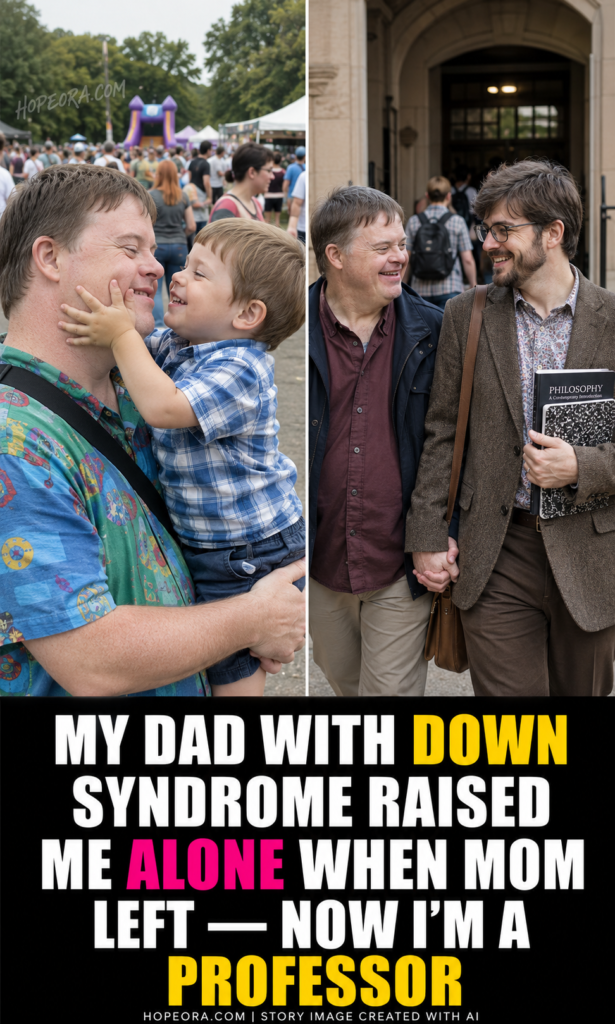
His dad, Aaron, has Down syndrome.
From the beginning, many people expected that raising a child alone would be more than he could handle. Some likely assumed someone else would step in to take responsibility. Others may have doubted that he could navigate the demands of parenthood after Ethan’s mother walked away.
Aaron made a different decision.
He didn’t spend his time chasing after someone who had already left.
He picked up his son.
He grabbed a diaper bag.
Then he got on with what needed to be done.
One of his first stops was the clinic, where paperwork and procedures waited alongside the uncertainty of becoming a single parent. Aaron signed every form placed in front of him. When a worker questioned the situation, his answer was simple and unwavering.
“He’s mine. I’m staying.”
There was no dramatic speech and no attempt to convince anyone. Just a straightforward declaration of responsibility.
Those words would define everything that followed.
Aaron earned his living repairing arcade machines. Instead of separating work and family, he found a way to make both fit together.
As a baby, Ethan often slept behind the counter while the sounds of flashing games, ringing bells, and electronic music filled the room. The arcade became more than a workplace. It became the place where father and son spent much of their time together, building a routine that worked for them.
As Ethan grew older, his role slowly changed.
His father placed a broom in his hands and showed him how to care for the business.
He learned how to wipe down game buttons until they shined, clear ticket jams when machines stopped working, and help keep the arcade running smoothly. These weren’t extraordinary lessons on their own, but together they taught responsibility, patience, and pride in doing a job well.
The skills Aaron passed along weren’t limited to the arcade.
Education became another part of their daily rhythm.
Evenings often ended with the two of them sitting together while Ethan studied. Aaron didn’t always understand every assignment or every lesson in front of them. Some subjects were unfamiliar or difficult for him to explain.
That didn’t stop him from being there.
He listened.
He repeated notes alongside his son.
He stayed beside him until the material began to make sense.
Aaron wasn’t pretending to know every answer. Instead, he offered something that proved just as valuable: consistency.
Night after night, he made sure Ethan never faced schoolwork alone.
Looking back as an adult, Ethan recognizes something he couldn’t fully appreciate while he was living it.
As a child, their routines simply felt normal.
Going to work with his father was normal.
Helping around the arcade was normal.
Studying together each evening was normal.
Only later did he understand how much quiet determination those ordinary moments contained.
The note he discovered at nineteen could easily have become the defining chapter of his family’s story. It explained how one parent left, but it also highlighted something else—the parent who stayed.
Aaron’s legacy was never built on dramatic moments.
It was built through thousands of ordinary choices.
Showing up each morning.
Going to work.
Packing up his son.
Helping with homework.
Teaching responsibility.
Being present.
Those decisions accumulated over the years until they formed the foundation of Ethan’s childhood.
When Ethan reflects on those years now, he doesn’t remember a life defined by what they lacked.
He remembers a life shaped by what they built together.
There were responsibilities, routines, lessons, and long days. There was work to do and homework to finish. There were machines to repair and floors to sweep. Through it all, there was always one constant.
His father was there.
The note his mother left behind answered one question that had lingered for years.
But it also revealed something far more important.
Aaron had never needed a perfect set of circumstances to become a devoted parent.
He simply chose, day after day, to keep moving forward.
Today, when Ethan looks back, he realizes they did far more than survive.
They didn’t merely get by.
Together, they built a life.
The hardships were real, but they were never the whole story. What stands out now is not the absence left behind by the person who walked away. It is the steady presence of the father who remained, who worked, who taught, and who loved through action more than words.
Sometimes the strongest examples of parenthood are found not in grand gestures but in quiet acts of commitment repeated over many years.
For Ethan, that is the story that deserves to be remembered.
Not the note that marked one person’s departure.
But the father who never stopped choosing to stay.
Have you ever realized, years later, that an ordinary part of your childhood was actually an extraordinary act of love by someone who cared for you?