For decades, Eleanor and Ruth built a life without the legal recognition of marriage. When the opportunity finally came in 2015, they embraced it without hesitation—and today, even in their second century of life, their love remains unmistakable.
Some love stories are remembered for grand gestures or dramatic beginnings. Others are defined by something quieter: the steady choice to remain beside one another through the passing of years.
Eleanor and Ruth’s story belongs to the second kind.
They met when they were both in their twenties, at a time when the future looked very different from the one they eventually came to know. What began as a relationship between two young women grew into a lifelong partnership built not on ceremony or public recognition, but on consistency. Day after day, year after year, they chose each other.
Long before they were legally allowed to marry, they had already built the foundations of a shared life.
Together, they worked, cared for family, and faced the countless responsibilities that fill ordinary lives. Their relationship wasn’t measured by milestones recognized on paper. Instead, it was reflected in everyday routines, shared responsibilities, difficult seasons, and quiet moments of support that accumulated over decades.
Like many same-sex couples of their generation, Eleanor and Ruth lived through an era when marriage simply wasn’t an option available to them. The legal barriers were clear, and there was little they could do to change them.
Rather than allowing that reality to define their relationship, they focused on what they could control.
They showed up for each other.
That commitment became the center of their life together. Through changing decades, shifting circumstances, and the natural challenges that come with growing older, they remained partners in every meaningful sense of the word.
Their story stretched across generations.
They witnessed enormous changes in the world around them while continuing to build a life rooted in mutual care and devotion. Trends came and went. Families grew and changed. The years accumulated almost unnoticed, one ordinary day at a time.
Their relationship endured not because every day was extraordinary, but because they continued choosing each other through the ordinary ones.
Then, after approximately seventy-five years together, something changed.
In 2015, same-sex marriage became legal nationwide in the United States, allowing couples like Eleanor and Ruth to marry legally after decades of waiting.
They didn’t hesitate.
By then, both women were already in their nineties. Some people might have wondered whether it was worth marrying after so many years together.
For Eleanor and Ruth, there was never any question.
They signed the papers.
They held hands.
Then they went home as wives.
There was no suggestion that a legal document suddenly created the love they shared. That love had existed for decades already. What changed was that the law could finally acknowledge what they had built together over a lifetime.
It was a moment that arrived late, but not too late.
Today, Eleanor is 101 years old, and Ruth is 102.
Age has naturally changed the rhythm of their days.
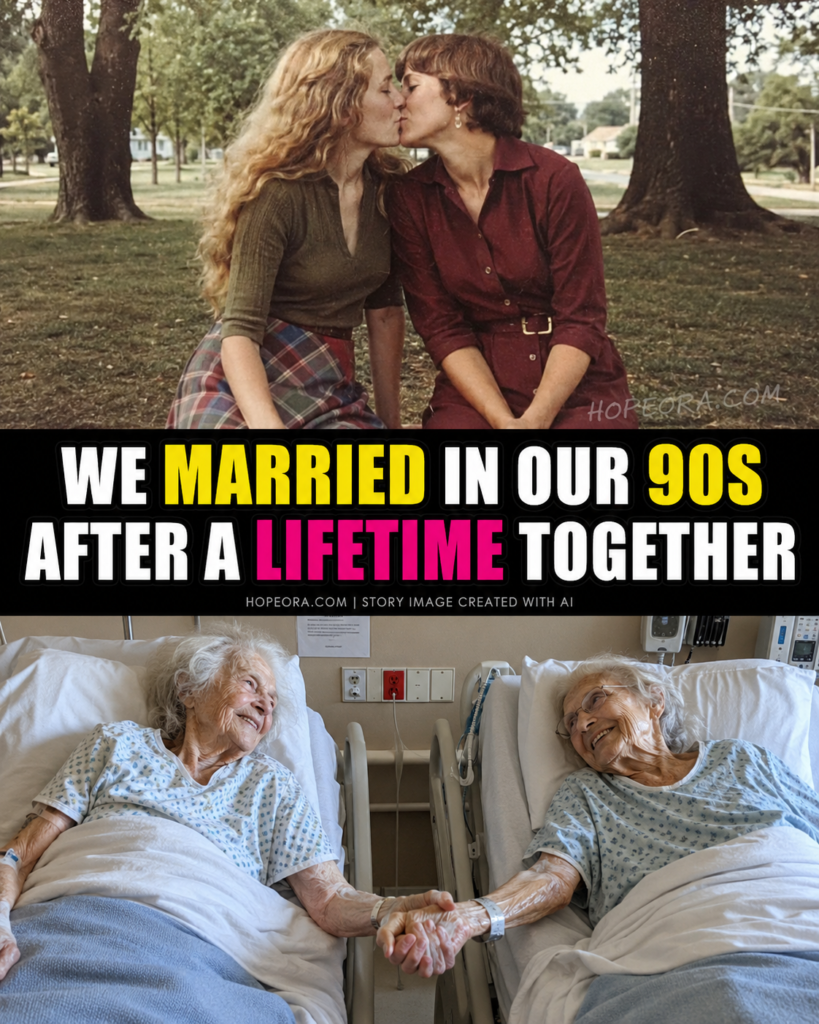
They move more slowly than they once did. Their world has become smaller, shaped by the realities that accompany life in its second century. They now share a hospital room, facing this chapter together just as they have faced every chapter before it.
Yet one habit remains unchanged.
Every morning, they reach for each other.
It’s a simple gesture, almost effortless in its familiarity, but it carries the weight of an entire lifetime. It reflects decades of shared mornings, shared evenings, shared worries, shared celebrations, and shared hope.
The passage of time has altered many things.
It has not altered that instinct.
Their story offers a reminder that enduring love is often found not in extraordinary declarations but in repeated acts of presence. It lives in showing up, remaining patient, adapting together, and continuing to reach for one another even when life becomes slower and more uncertain.
Looking back, Eleanor reflects on the journey with remarkable simplicity.
They waited a long time to say, “I do.”
But they never waited to love.
That distinction says everything.
The legal recognition they received in 2015 mattered deeply. It affirmed publicly what they had privately known for decades. Yet the foundation of their relationship had never depended solely on official recognition. It had been built every day through commitment, companionship, and shared experience.
For seventy-five years before their wedding day, they had already been creating the marriage they wanted to live, even without the legal title.
Their ceremony marked an important beginning in one sense, but it also honored a lifetime that had already been lived together.
Now, more than a decade after exchanging vows, the image that best captures Eleanor and Ruth’s relationship isn’t necessarily the moment they signed their marriage papers.
It’s the quieter picture that comes afterward.
Two women, now 101 and 102 years old, waking each morning in the same hospital room and instinctively reaching for each other’s hand.
After all these years, that small gesture says what words no longer need to explain.
Love, patiently lived, can outlast decades of waiting. It can endure changing laws, changing bodies, and changing seasons of life. And sometimes its greatest strength is revealed not through extraordinary moments, but through the quiet certainty of never letting go.
Reader Invitation
What everyday gesture do you think says the most about a lifelong relationship?